
Turbo Blower Efficiency and Harmonic Compliance at a Municipal Wastewater Plant — Mirus International
| Client | Cities of South San Francisco / San Bruno Water Quality Control Plant (WQCP) |
| Application | Aeration blower replacement — biological wastewater treatment |
| Blower | 350 HP APG-Neuros Air Turbo Blower (aerospace-derived technology) |
| Drive | Variable Frequency Drive (VFD) — utility connected |
| Harmonic filter | Mirus Lineator AUHF HP model |
| Harmonic spec | ITDD < 5% at blower package terminals across entire operating range |
| Mirus representative | Power Quality Concepts (local) |
| Measured ITDD (full speed) | 4.56% — below 5% limit, better than SOLV™ prediction |
| Measured THDv (full load) | 2.15% — never exceeded 2.5% across operating range |
| Estimated annual energy savings | $55,000 USD |
| Payback period | Less than 4 years |
01 Operating Context: Energy Audit Drives a Blower Technology Change
The Cities of South San Francisco and San Bruno jointly operate a Water Quality Control Plant (WQCP) — a municipal wastewater treatment facility serving both communities. Facing pressure to reduce energy consumption and operating costs, the WQCP commissioned an energy audit to identify where electrical power was being consumed and where efficiency improvements would deliver the greatest return.[1]
The audit result was unambiguous: the aeration blowers consumed more electrical power than any other system in the plant. Aeration is the process of forcing air into the biological treatment tanks to sustain the aerobic bacteria that break down organic waste — it is the heart of the biological treatment process, and it runs continuously. In a typical municipal wastewater treatment plant, aeration accounts for 50–70% of total plant electrical energy consumption. Improving blower efficiency is the single highest-impact energy measure available.
California’s aggressive environmental policy provided additional incentive: state programs offer financial incentives for energy efficiency investments that reduce emissions. The combination of energy savings, operational cost reduction, and available incentives made the business case for blower replacement compelling.[1]
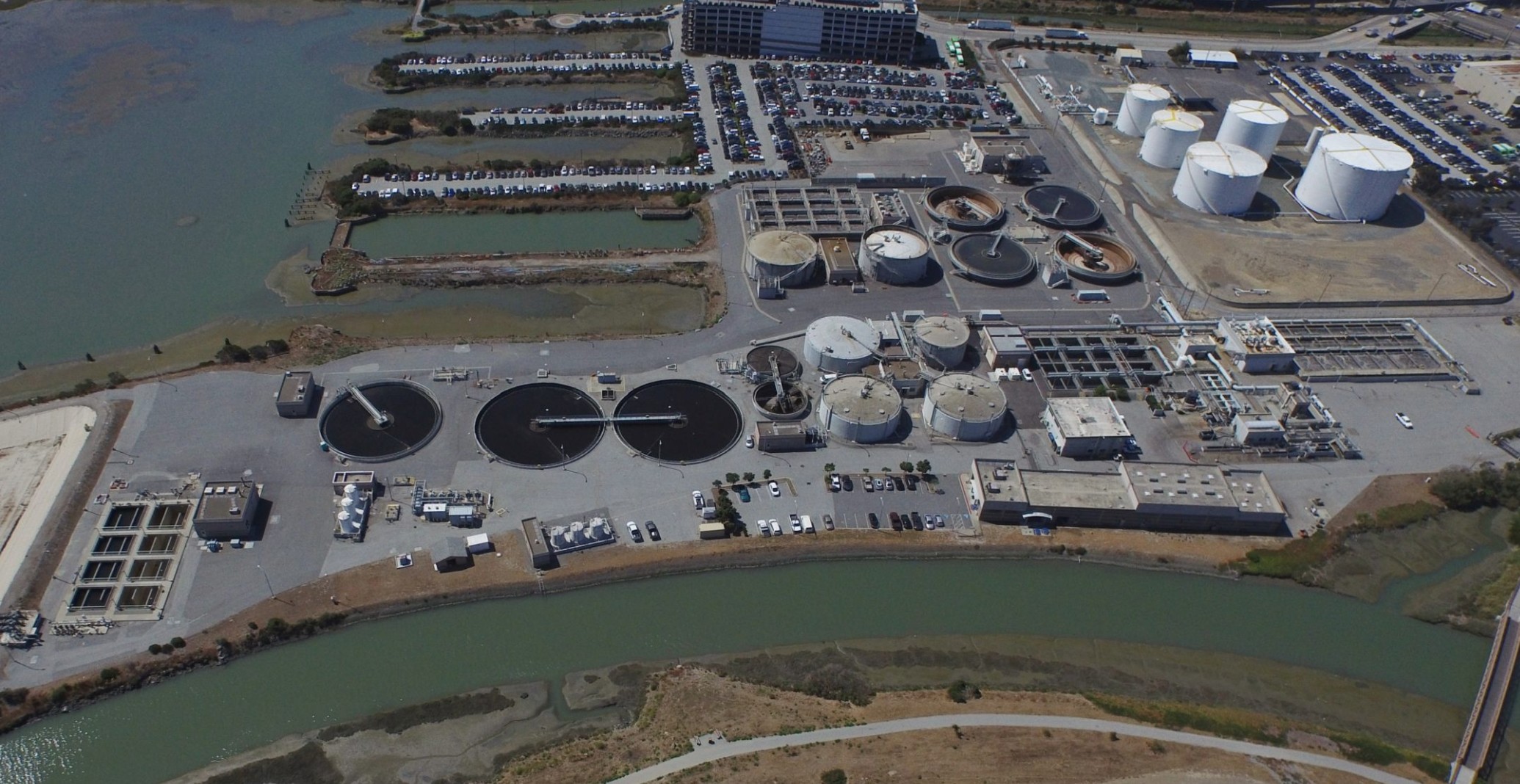
Fig. 1. Aerial view of the South San Francisco / San Bruno Water Quality Control Plant. The circular aeration tanks dominate the facility footprint — aeration is the largest electrical load in the plant. Source: Mirus International.[1]
1.1 The turbo blower technology
The WQCP selected the APG-Neuros Air Turbo Blower — a technology derived from aerospace and defense turbomachinery rather than conventional industrial blower design. The performance advantages over conventional centrifugal and positive-displacement blowers are substantial: at least 40% improvement in energy efficiency and a 50% reduction in physical footprint. APG-Neuros is the recognized North American market leader for turbo blower systems in wastewater treatment.[1]
The turbo blower operates at variable speed, controlled by a VFD, to match air output precisely to biological process demand. Variable speed operation is what produces the energy savings — the blower slows down when less aeration is needed and speeds up when demand increases, rather than running at fixed speed and throttling airflow mechanically. This is the same efficiency principle that makes VFDs valuable across all variable-torque pump and fan applications.
02 ITDD vs. THDi: The Correct Metric for Variable-Speed Loads
The project specification called for total current demand distortion (ITDD) below 5% — not THDi. This distinction is important and worth understanding, because IEEE 519 uses ITDD as its primary current harmonic metric at the point of common coupling, and the two measures behave very differently at light load.[2]
2.1 THDi — a percentage of the fundamental
THDi expresses harmonic current as a percentage of the fundamental-frequency current at the moment of measurement. At light load, the fundamental current is small. The harmonic currents, while small in absolute terms, represent a large fraction of a small fundamental — producing high THDi. A VFD at 25% load might show 35–40% THDi while the absolute harmonic current magnitude is far smaller than at full load. THDi alone can make a lightly loaded drive look like a worse harmonic problem than a heavily loaded one.
2.2 ITDD — a percentage of rated demand current
ITDD expresses harmonic current as a percentage of the rated demand load current — the full-load current the equipment is designed to draw — rather than the instantaneous fundamental. This denominator is fixed, not variable. The result is a metric that scales with actual harmonic impact: at light load, both harmonic currents and ITDD are small; at full load, both are at their maximum. ITDD tracks the actual harmonic burden on the network in a way that THDi does not.[2]
03 A Three-Party Solution: APG-Neuros, Power Quality Concepts, and Mirus
3.1 The packaging challenge
APG-Neuros’ turbo blower system is supplied as a compact integrated package — blower, motor, VFD, and controls in a single enclosure. The 50% footprint advantage over conventional blowers is a key selling point, and any harmonic filter added to the system had to fit within the existing enclosure without compromising that advantage. This ruled out bulky add-on filter cabinets and required close engineering collaboration between APG-Neuros and Mirus.[1]
3.2 Simulation and local expertise
Power Quality Concepts — the Mirus International representative for the region — provided the harmonic mitigation expertise for the project. Using SOLV™, Mirus ran several simulation scenarios to determine which Lineator model and configuration would meet the 5% ITDD specification across the blower’s full operating speed range. The simulation identified the Lineator AUHF HP model as the correct solution.[1]
The local consulting engineer reviewing the project was already familiar with the Lineator product line and accepted the SOLV™ simulation results — but required post-installation field measurement to formally confirm compliance. This is the correct professional engineering approach: simulation informs design, measurement confirms performance.
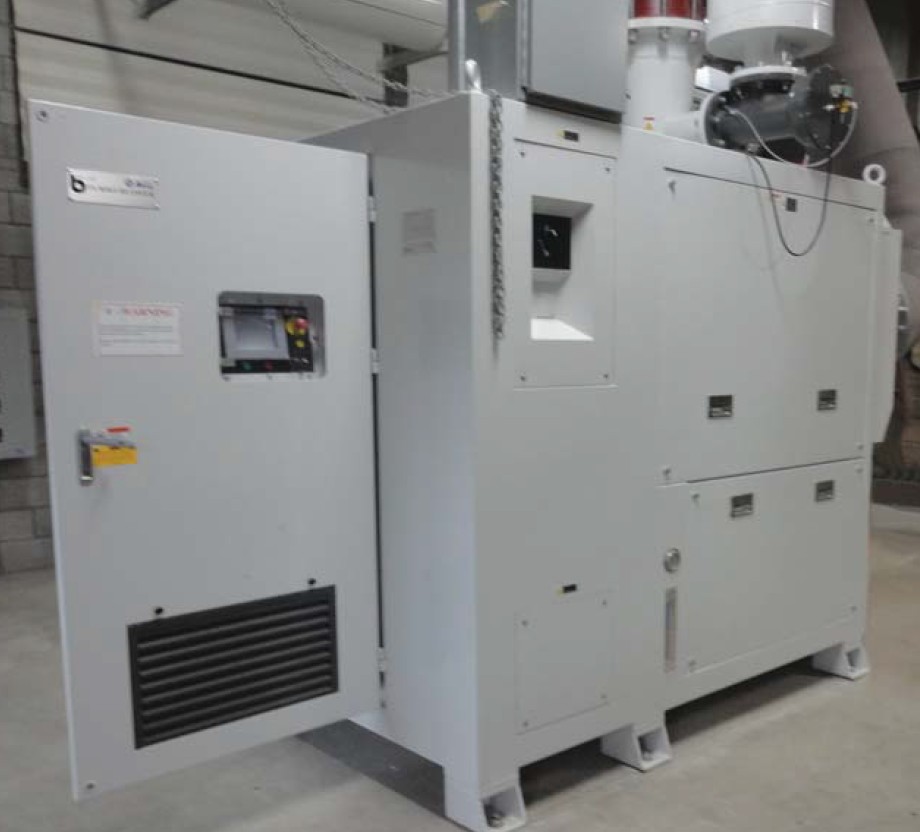
Fig. 2. The Mirus Lineator AUHF HP installed within the APG-Neuros Turbo Blower system enclosure. The Mirus engineering team collaborated with APG-Neuros to develop a packaging solution that maintained the system’s compact footprint. Source: Mirus International.[1]
3.3 Integrated packaging
The Mirus engineering team worked directly with APG-Neuros engineers to develop a Lineator package configuration that fitted within the turbo blower system enclosure. The result was a fully integrated harmonic filter solution — invisible to the end user, maintaining the compact system footprint, and delivering the required harmonic performance across the full speed range.[1]
04 Results: Measured Performance Exceeds Prediction and Specification
Field measurements were conducted at various load levels following installation to formally confirm compliance. The results exceeded both the SOLV™ simulation prediction and the project specification:[1]
ITDD was maintained comfortably below 5% across the entire operating speed range — not just at full load. THDv never exceeded 2.5% at any operating point. The 4.56% ITDD at full speed actually improved on the SOLV™ prediction, consistent with the pattern seen across other Mirus case studies where conservative simulation assumptions produce real-world results that outperform the model.
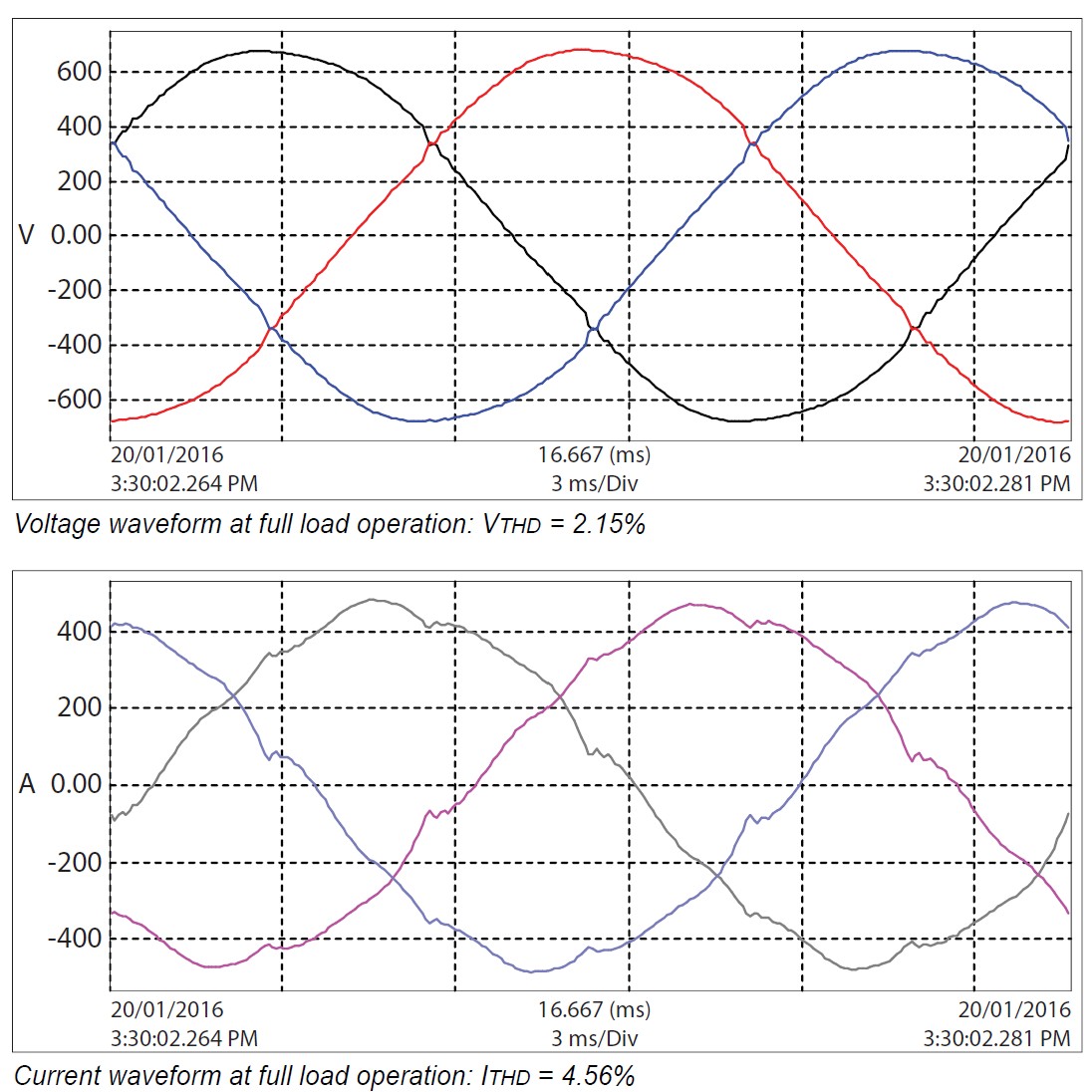
Fig. 3. Measured waveforms at full load operation (20 January 2016). Top: voltage waveform, THDv = 2.15% — clean sinusoid. Bottom: current waveform, ITDD = 4.56% — near-sinusoidal with minimal harmonic distortion. Source: Mirus International.[1]
05 The Power Quality Perspective: What This Case Study Illustrates
5.1 A utility-connected system — a different problem class
Every previous case study in this series involved a generator-fed islanded system. The WQCP is the first utility-connected application in the series. The harmonic consequence is different: with utility supply, source impedance is low and the voltage distortion from a single 350 HP drive is modest. The compliance driver here is not system stability or equipment protection — it is the IEEE 519 current distortion limit at the point of common coupling, which the utility uses to protect all other customers on the shared network from the harmonic current injected by this load.
This is the context in which IEEE 519 was written: a utility serving many customers, establishing limits on how much harmonic current any single customer can inject into the shared network. The WQCP’s obligation under IEEE 519 is to limit its harmonic injection — ITDD at the PCC — to levels that do not significantly degrade power quality for neighbouring customers. The 5% ITDD specification in the project documents directly reflects this obligation.[2]
5.2 Harmonic filtering as part of equipment procurement
The most important structural feature of this case study is that harmonic filtering was specified as part of the blower package procurement — not as a retrofit. The WQCP did not buy a turbo blower, install it, measure the harmonics, and then add a filter. The project specification included the ITDD limit from the outset, APG-Neuros was responsible for delivering a compliant integrated package, and Mirus was engaged at the design stage to size and package the filter before any equipment was ordered.
This is the correct procurement model. It aligns responsibility for harmonic compliance with the party that controls the harmonic source — the equipment supplier — rather than leaving it as a site problem for the plant electrical engineer to solve after installation. It also enables the packaging optimization that kept the system within its compact footprint.
5.3 The role of the local Mirus representative
Power Quality Concepts — the local Mirus representative — ran the SOLV™ simulations that defined the filter specification and provided the technical interface between APG-Neuros, the consulting engineer, and Mirus’ engineering team. This is the distribution model for applied power quality engineering: a manufacturer with simulation capability and product depth, represented locally by a specialist who understands the regional utility, the consulting engineering community, and the specific application requirements. The local representative’s existing relationship with the consulting engineer — who was already familiar with the Lineator product — was a factor in the project proceeding efficiently.
This pattern — manufacturer technical depth, local representative application knowledge, consulting engineer third-party validation — is a model worth noting for anyone building a power quality consulting practice. The local representative role is where the client relationship lives.
References
- [1] Mirus International Inc., “Case Study: Water Quality Control Plant Turbo Blower Replacement Project,” Application Case Study, Brampton, Ontario, Canada. Available: mirusinternational.com
- [2] IEEE Std 519-2022, “IEEE Standard for Harmonic Control in Electric Power Systems,” IEEE, New York, NY, 2022.