
Harmonic Compliance for Nine Panamax Bulk Carriers: CSL Group and the Great Lakes Seaway — Mirus International
| Client | The CSL Group Inc. — Montréal, Québec (world’s largest self-unloading vessel operator) |
| Shipyard | Chengxi Shipyard Co. Ltd., Jiangyin City, China |
| Fleet | 9 Panamax self-unloading bulk carriers |
| Certification required | Lloyd’s Registry + American Bureau of Shipping (ABS) — THDv < 5% |
| THDv at sea trials | Nearly 35% — exceeded limit by approximately 30% |
| Harmonic filter | Mirus Lineator AUHF — applied to largest VFDs on each vessel |
| Group A (4 vessels) | 4 × 400 HP unloading conveyor drives + 2 × 400 HP ballast pump drives |
| Group B (5 vessels) | 4 × 400 HP unloading conveyor drives + 2 × 350 HP ballast pump drives |
| Post-filter THDv | Well within < 5% on all nine vessels (SOLV™ simulation confirmed) |
| Operating routes | Great Lakes Seaway (Duluth, MN to Gulf of St. Lawrence) + blue water international |
01 Operating Context: CSL Group and the Panamax Fleet
The CSL Group Inc. is a Montréal-based privately-owned shipping company and the world’s largest owner and operator of self-unloading vessels. Its fleet transports dry bulk cargo — iron ore, grain, coal, salt, aggregates, sugar — to customers across construction, steel, energy, and agri-food industries globally. CSL delivers more than 70 million tonnes of dry-bulk cargo annually.[1]
CSL commissioned nine new Panamax-class self-unloading vessels from Chengxi Shipyard Co. Ltd. in Jiangyin City, China. Panamax designates the largest vessel class that can transit the Panama Canal — engineered to fit the canal’s minimum lock dimensions while carrying maximum permitted cargo. These are not small ships.
Four of the nine vessels were designated for Great Lakes Seaway operation — the Duluth, Minnesota to Gulf of St. Lawrence route — as Laker Trillium Class units. The remaining five were ocean-bound for blue water international routes. Both categories required certification by Lloyd’s Registry and the American Bureau of Shipping (ABS) before entering service, and both certification bodies impose a hard limit: total harmonic voltage distortion (THDv) on the vessel electrical supply system must not exceed 5%.[2][3][1]
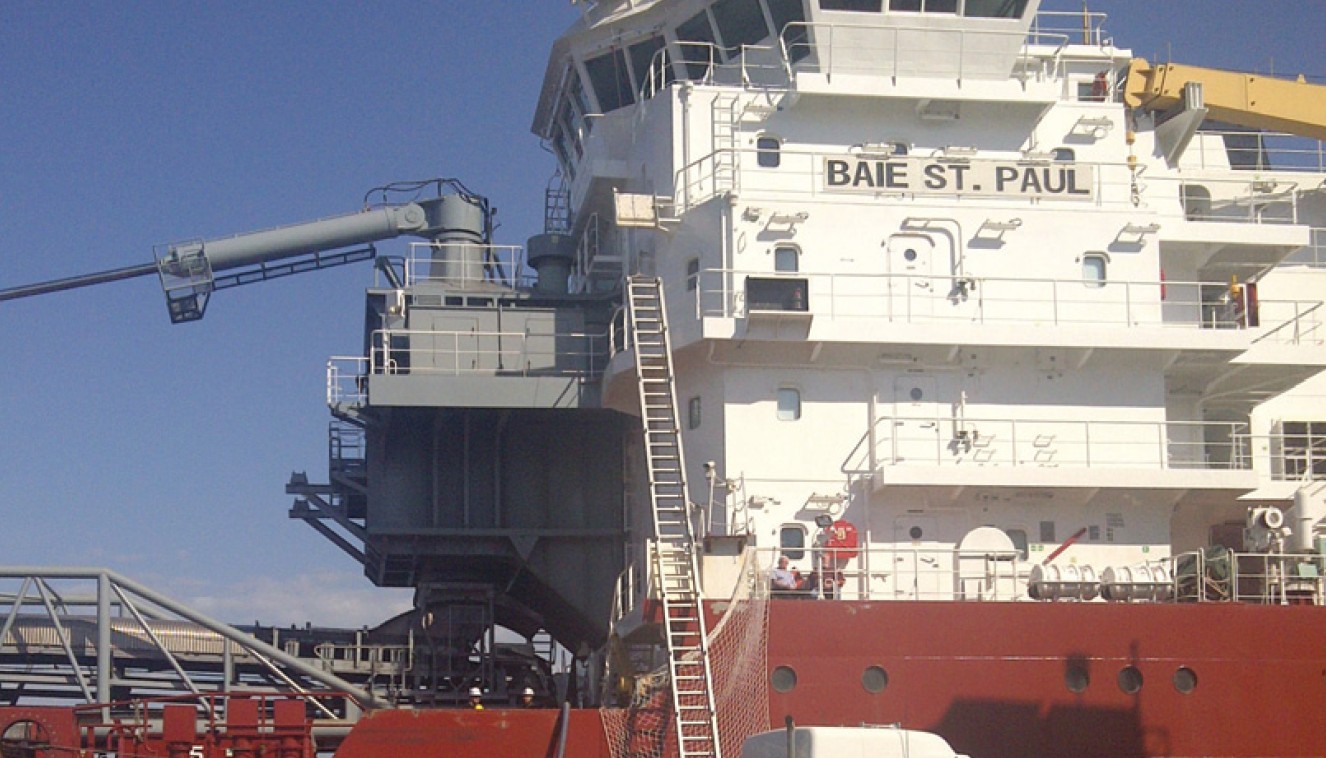
Fig. 1. CSL vessel Baie St. Paul — one of four Laker Trillium Class Panamax self-unloading vessels destined for Great Lakes Seaway operation. Source: Mirus International / CSL Group.[1]
02 The Discovery: 30% Over the THDv Limit at Sea Trials
During sea trials in China, CSL discovered that the THDv on the vessels’ electrical supply systems exceeded the 5% Lloyd’s/ABS limit by approximately 30% — meaning measured THDv was in the range of 30–35%. The ships could not be certified and could not enter service until this was resolved.[1]
CSL engaged Mirus International to provide a harmonic mitigation solution for the entire fleet. Mirus began with their standard methodology: simulation first, then field measurement to validate the model.
2.1 Simulation with SOLV™
Mirus engineers used their proprietary SOLV™ harmonic simulation software to model each vessel’s complete electrical system — generators, distribution architecture, and all VFD loads at various operating conditions. The simulation produced predicted THDv levels at the key measurement points required by the certification bodies.[1]
2.2 On-board field measurement
To validate the SOLV™ model, Mirus engineers boarded one of the ships and performed on-site harmonic measurements. The field-measured THDv values matched closely with both the SOLV™ simulation predictions and CSL’s own sea trial measurements — confirming that the simulation model accurately represented the actual vessel electrical system. This three-way agreement (simulation, Mirus field measurement, CSL sea trial) gave strong confidence in the post-filter predictions.[1]
03 VFD Loads on Modern Bulk Carriers: Why Harmonics Are Unavoidable
The CSL Panamax vessels represent the current state of the art in bulk carrier design. Variable frequency drives are deployed throughout — not as an afterthought, but as a core efficiency strategy:[1]
- Thruster drives — vessel manoeuvring and station-keeping
- Ballast pump drives — trim and stability management (2 × 350–400 HP per vessel)
- Self-unloading conveyor drives — the defining capability of a self-unloading vessel; the conveyor system discharges cargo without shore-based equipment (4 × 400 HP per vessel)
- Ventilation fan drives — hold and machinery space ventilation, speed-controlled for efficiency
Each of these drive systems offers real operational benefits: reduced fuel consumption at partial load, precise speed control, reduced mechanical wear. But collectively, they represent a heavy concentration of 6-pulse non-linear loads on a vessel power system supplied entirely by on-board generators — the same high-source-impedance, islanded-system problem encountered in the previous case studies in this series, scaled up to a fleet of nine vessels.
3.1 The unloading conveyor — a concentrated harmonic source
The self-unloading conveyor system is the defining technology of CSL’s vessels and the largest harmonic source on board. Four 400 HP conveyor drives operating simultaneously represent 1,600 HP of 6-pulse rectifier load on a single vessel bus. When these drives operate at full capacity during cargo discharge — which is exactly when the vessel is near a port, operating with limited generator redundancy — the harmonic loading on the vessel electrical system is at its maximum.
This is the worst-case scenario that sea trials must demonstrate compliance for, and it is precisely the scenario that produced the 30%+ THDv exceedance that blocked certification.
04 Solution: Lineator AUHF on the Largest Drives, Fleet-Wide
4.1 Filter placement strategy
After simulation and analysis, Mirus engineers recommended applying Lineator AUHF filters to the largest VFDs on each vessel — specifically the conveyor drives and ballast pump drives. This selective placement strategy reflects an important principle of harmonic mitigation: the largest drives produce the largest absolute harmonic currents and therefore have the greatest impact on bus THDv. Mitigating the dominant harmonic sources achieves compliance without requiring filters on every drive aboard.[1]
| Vessel group | Vessels | Conveyor drives filtered | Ballast pump drives filtered | Total filter capacity |
|---|---|---|---|---|
| Group A — Great Lakes | 4 | 4 × 400 HP | 2 × 400 HP | 2,400 HP per vessel |
| Group B — Ocean | 5 | 4 × 400 HP | 2 × 350 HP | 2,300 HP per vessel |
4.2 Simulation-confirmed compliance
SOLV™ simulations with the Lineator filters installed showed THDv reduced to well within the 5% Lloyd’s/ABS limit on all nine vessels under all operating conditions modelled. The same close agreement between simulation and field measurement that had characterized the pre-filter baseline gave confidence that the post-filter simulation results were reliable predictions of what sea trials would confirm.[1]
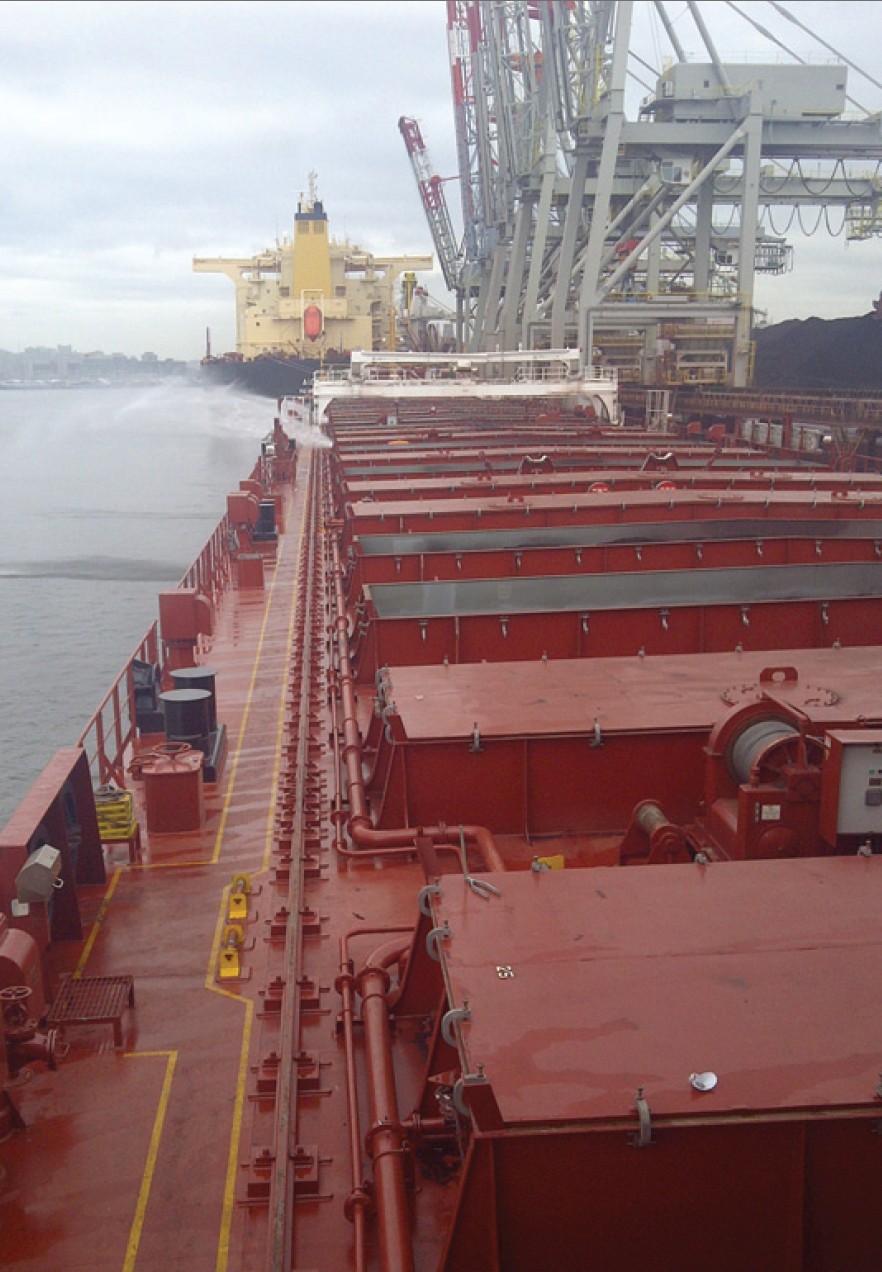
Fig. 2. Deck view of a CSL Panamax self-unloading vessel showing the conveyor infrastructure. The four 400 HP conveyor drives represent the dominant harmonic source on the vessel bus and were the primary targets for Lineator AUHF installation. Source: Mirus International / CSL Group.[1]
05 The Power Quality Perspective: What This Case Study Illustrates
5.1 Discovering harmonic problems at sea trials — a recurring pattern
The CSL case shares a structural feature with the offshore service vessel case studied earlier in this series: harmonic compliance was not verified during vessel design and was discovered only at sea trials. In both cases, the vessel was built and ready for service before the electrical system was tested under real operating conditions with all major loads running simultaneously.
This pattern is preventable. Harmonic simulation during the design phase — before shipyard construction — can identify whether the planned VFD complement will produce compliant THDv under all operating scenarios. The cost of a SOLV™ simulation at design stage is a fraction of the cost of a post-construction retrofit solution. For a nine-vessel fleet, the argument for early harmonic analysis is compelling.
5.2 Selective filter placement — the dominant-source strategy
The decision to filter only the largest drives — conveyors and ballast pumps — rather than all drives on the vessel is the correct engineering approach when the harmonic budget is dominated by a few large loads. The 6-pulse rectifier harmonic current magnitude scales roughly with drive size. The four 400 HP conveyor drives and two 400 HP (or 350 HP) ballast pump drives together represent roughly 2,300–2,400 HP of non-linear load per vessel. The remaining drives — thruster drives, ventilation fans — are smaller and their contribution to bus THDv, while real, is secondary.
Filtering the dominant sources brings THDv within the 5% limit. Filtering every drive would add cost and complexity without proportional improvement in compliance margin. The SOLV™ simulation quantified exactly how much improvement each filter placement produced, enabling the selective strategy to be validated before any hardware was ordered.
5.3 Simulation-measurement agreement as an engineering tool
The close three-way agreement between SOLV™ simulation, Mirus field measurements, and CSL’s own sea trial data is worth emphasizing as a methodology point. When a simulation model is validated against independent field measurements before a solution is implemented, the post-solution simulation result carries real predictive weight. This is different from simulation alone, which depends on the accuracy of the input data and assumptions.
For a nine-vessel fleet, boarding every ship for post-filter measurement would be time-consuming and costly. The validated model makes it defensible to apply the same filter specification across the full fleet — once the model is confirmed accurate on one vessel, the prediction for the others is reliable. This is simulation as an engineering tool, not as a sales presentation.
References
- [1] Mirus International Inc., “Case Study: CSL Group Inc. — Panamax Vessels Harmonic Mitigation,” Application Case Study, Brampton, Ontario, Canada. Available: mirusinternational.com
- [2] American Bureau of Shipping (ABS), “Guidance Notes on Control of Harmonics in Electrical Power Systems,” ABS, Houston, TX.
- [3] Lloyd’s Register, “Rules and Regulations for the Classification of Ships,” Lloyd’s Register, London, UK.