
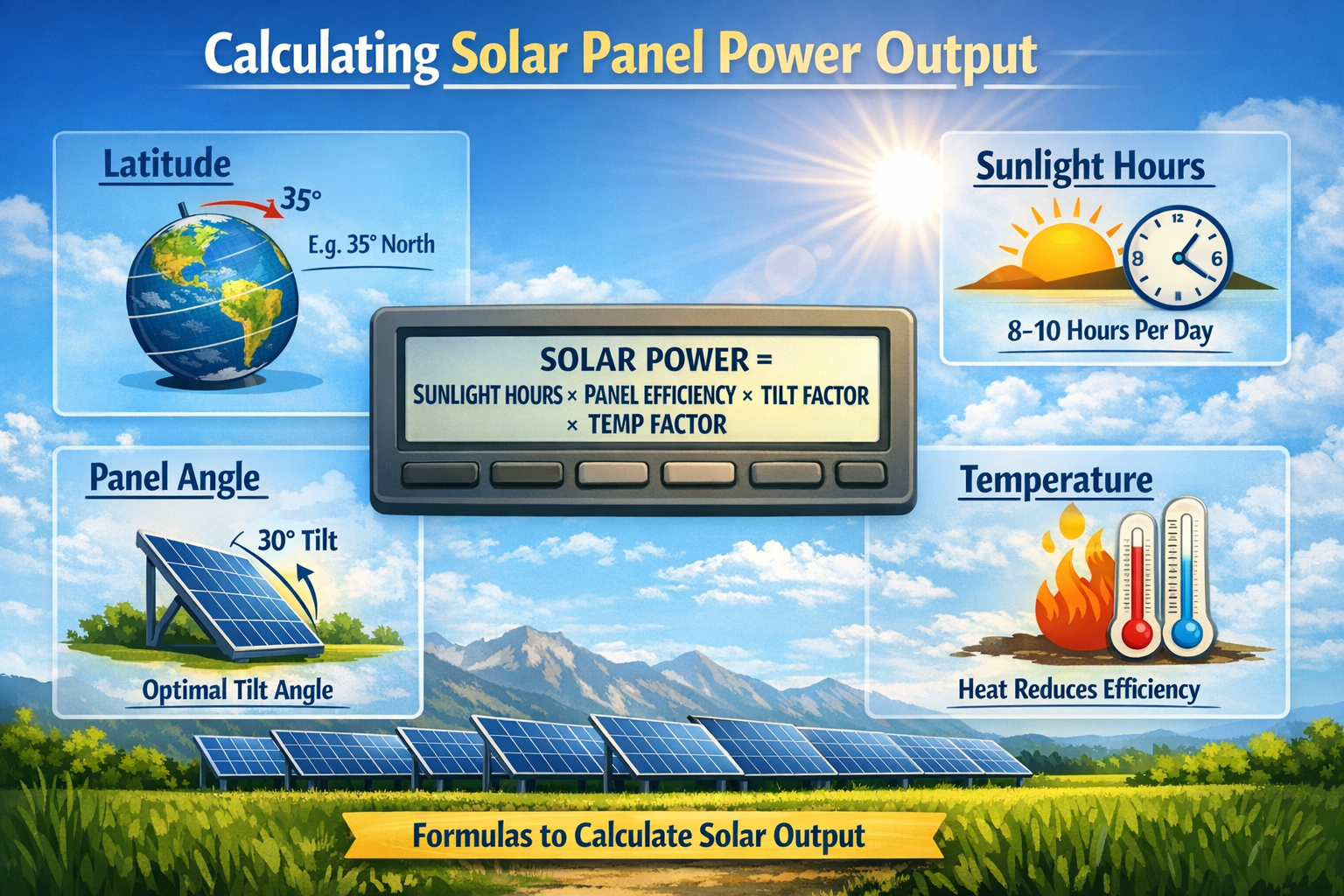
📐 The Foundational Solar Output Equation
A widely used formula to estimate the energy output of a photovoltaic (PV) system is the following [1]:
However, to better integrate your specific variables, we can expand this into a more detailed form, commonly used for system sizing and implemented in recognized models like NREL’s PVWatts [4]:
Let’s define each term in this expanded equation [4, 8]:
- Ppv : The total energy output (in kWh) over a given period (e.g., daily, monthly, or annually) or the power output (in W) [4].
- Pstc : The total rated power of your solar array (in kWdc) under Standard Test Conditions (STC: irradiance of 1000 W/m², cell temperature of 25°C) [1, 4]. This is the “size” of your system.
- Htilt : The daily, monthly, or annual solar irradiation (in kWh/m²) on the plane of your solar array (Plane of Array or POA). This is where latitude and panel angle are used to calculate the sunlight your specific setup receives [5, 7].
- ftemp : The temperature derating factor (a decimal between 0 and 1). This accounts for the loss in efficiency as the solar panel’s cell temperature rises above 25°C [1, 2, 8].
- fother : A combined factor for all other system losses (a decimal between 0 and 1). This includes soiling (dust), shading, wiring losses, inverter efficiency, and more [1, 4].
🔍 Breaking Down the Key Components
To make this equation work, you need to determine the specific values for Htilt and ftemp.
1. Irradiation on a Tilted Surface ()
This is the most complex part, as it combines your location (latitude) and panel angle. The annual optimal fixed tilt angle for a location is often approximated by its latitude [5]. However, for maximum accuracy, a more nuanced approach is needed.
- Fixed Tilt Angle: The “golden rule” is to set the tilt angle equal to your latitude. For example, at a latitude of 35°N, panels are often installed with a 35° tilt [5].
- Calculating Htilt: Manually calculating the irradiation on a tilted plane is complex. It requires splitting horizontal solar radiation data into its direct and diffuse components and then transposing them to the tilted plane [7]. For this reason, professionals use tools like the European Commission’s PVGIS (Photovoltaic Geographical Information System) [3] or NREL’s PVWatts in the United States [4]. By inputting your location (latitude/longitude), panel tilt, and orientation (azimuth), these tools provide an accurate value for Htilt. More recent approaches even use machine learning to improve the accuracy of these estimates compared to traditional isotropic models [7].
2. The Temperature Derating Factor (ftemp)
Solar panels operate less efficiently as they get hot. This factor corrects for this effect [1, 2]. The formula, implemented in models like PVWatts, is as follows [4, 8]:
- γ : The power temperature coefficient provided by the manufacturer. For crystalline silicon, it is typically expressed in %/°C and is negative [6, 10].
- Tcell : The estimated operating cell temperature (°C). More sophisticated models also account for wind speed and irradiance [1, 9].
- Tstc : The cell temperature at standard test conditions (STC), which is always 25°C [4].
For example, according to industry data, for a module with γ=−0.4%/°C, Tcell=65°C, and Tstc=25°C, the power loss is significant [6]. The calculation is:
This means the panel is operating at only 84% of its rated power due to the high temperature.
Typical Temperature Coefficient (γ) Values
The table below presents typical values for different panel technologies, based on research and industry data [2, 6, 10]:
| Panel Technology | Typical Temperature Coefficient (γ) | Notes |
|---|---|---|
| Monocrystalline Silicon (Older BSF) | -0.45% to -0.50% /°C | Older technology with higher temperature losses [6]. |
| Monocrystalline Silicon (Modern PERC) | -0.35% to -0.40% /°C | Common technology with improved performance [6]. |
| Monocrystalline Silicon (N-type TOPCon) | -0.29% to -0.35% /°C | Advanced technology with a very good coefficient [6]. |
| Monocrystalline Silicon (HJT – Heterojunction) | -0.25% to -0.30% /°C | Premium technology with the best coefficient [6]. |
| Polycrystalline Silicon | -0.40% to -0.50% /°C | Older technology, generally higher coefficient [6]. |
| Thin-Film (CdTe) | -0.24% to -0.25% /°C | Very good performance in heat [6]. |
| Field-Aged Modules | -0.5% /°C (for ηm) | Measurements on aged modules confirm these orders of magnitude [2]. |
3. Other Derating Factors (fother)
This is a catch-all for real-world inefficiencies. A typical value for a well-designed system might be around 0.75 to 0.85 [1]. You can calculate it by multiplying individual factors together [4].
💡 A Practical Example
Let’s combine these for a simplified annual estimate for a 1 kWdc system using the PVWatts formula [4, 8].
- Array Power (Pstc): 1 kWdc
- Tilted Irradiation (Htilt): Let’s assume you’ve used an online tool like PVGIS [3] for your specific latitude and chosen tilt. The tool outputs an annual Htilt of 1700 kWh/m².
- Temperature Factor (ftemp): Based on your local climate and panel specifications (e.g., γ=−0.4%/°C [6]), you calculate an average annual ftemp of 0.90.
- Other Losses (fother): You estimate a combined factor of 0.80 for inverter losses, soiling, wiring, etc. [1, 4].
Your estimated annual energy output (Ppv) would be [4]:Ppv=1 kWdc×1700 kWh/m²×0.90×0.80=1224 kWh
This means your 1 kWdc system is expected to generate about 1224 kWh of electricity per year under these conditions.
🧠 Recommendations for the Most Accurate Results
- Use Professional Tools: For the most reliable values, I strongly recommend using established tools like PVGIS [3] or PVWatts [4]. They handle the complex geometry of sun position and radiation conversion for you [7].
- Consult the Datasheet: The most accurate value for the temperature coefficient (γ) will always come from the manufacturer’s datasheet for the specific solar panel model you are using [6, 10]. Look for “Temperature Coefficient of Pmax” or “Power Temperature Coefficient”.
- Gather Quality Input Data: The accuracy of your equation depends on your inputs. Use site-specific data for average temperatures and the exact technical details of your panels [1, 2, 9].