
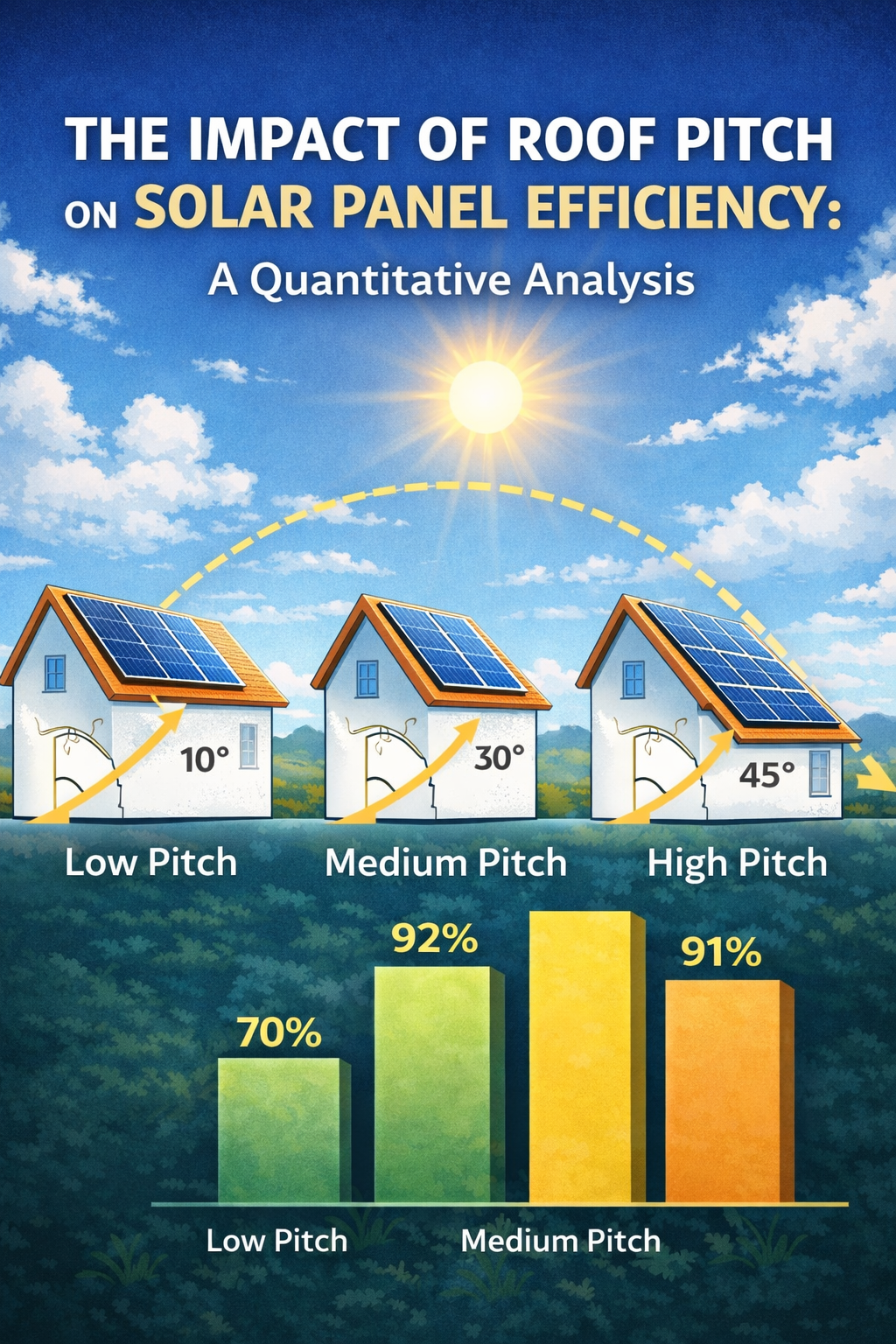
🌞 Introduction: La géométrie de la capture de l’énergie solaire
La relation fondamentale entre l’orientation d’un panneau solaire et sa production d’énergie est régie par les principes de base de la géométrie et du rayonnement solaire.. Lorsque la lumière du soleil frappe un panneau selon un angle perpendiculaire, la densité énergétique est maximisée, et le panneau fonctionne à son efficacité maximale théorique [1]. Lorsque l'angle d'incidence s'écarte de la perpendiculaire, le même flux solaire est réparti sur une plus grande surface, réduisant l'intensité du rayonnement par unité de surface et diminuant par conséquent la puissance de sortie [2].
Pour les installations photovoltaïques fixes, l'objectif est d'identifier l'angle d'inclinaison optimal qui maximise la capture d'énergie annuelle. Cet angle optimal est principalement déterminé par la latitude géographique, avec la règle générale suggérant que le réglage de l'inclinaison égale à la latitude optimise la production toute l'année [3]. Des ajustements saisonniers peuvent être effectués en ajoutant 10-15 degrés pour favoriser la production hivernale lorsque la course du soleil est plus basse, ou soustraire 10-15 diplômes pour valoriser la génération estivale [4].
Cependant, les installations résidentielles et commerciales sur les toits sont confrontées à une contrainte inhérente: la pente du toit existante dicte l'angle d'inclinaison disponible. Cette limitation introduit la question critique abordée dans cette analyse: quelle quantité de puissance est perdue lorsque l'angle du toit s'écarte de l'inclinaison optimale?
📐 Le cadre mathématique: Rayonnement solaire sur des surfaces inclinées
Quantifier la relation entre l'angle du toit et la puissance de sortie, nous devons d'abord établir les équations régissant le rayonnement solaire incident sur une surface inclinée. Alors que des modèles complets tiennent compte du rayonnement diffus du ciel et des composantes réfléchies par le sol, le facteur dominant est généralement le rayonnement direct du faisceau [5].
Une expression simplifiée reliant le rayonnement sur un module incliné à celui sur une surface horizontale est donnée par:
Où:
- = rayonnement solaire sur le module incliné (W/m²)
- = rayonnement solaire sur une surface horizontale (W/m²)
- un = angle d'élévation solaire (degrés au-dessus de l'horizon)
- b = angle d'inclinaison du module par rapport à l'horizontale (degrés) [6]
Cette relation peut être dérivée en considérant le rayonnement incident perpendiculairement aux rayons du soleil. ():
L'objectif des panneaux inclinables est de maximiser terme, rapprochant ainsi la surface du module de l'alignement perpendiculaire avec les rayons du soleil [7]. Il est important de noter que ces équations représentent généralement les conditions à midi solaire, lorsque le soleil atteint son élévation maximale.. Une analyse annuelle complète nécessite d’intégrer ces calculs sur l’ensemble de la trajectoire journalière et saisonnière du soleil. [8].
⚖️ Quantification de la perte de puissance: Angle du toit et inclinaison optimale
Lorsque l'angle réel du toit () diffère de l’inclinaison théoriquement optimale (), l'écart qui en résulte réduit directement le rayonnement incident et, par conséquent, production annuelle d'énergie. Les données industrielles et les études de simulation fournissent des estimations quantifiables de ces pertes.
Selon le Laboratoire National des Energies Renouvelables (NREL), les écarts de10 degrés de l'inclinaison optimale peut réduire la production annuelle d'énergie d'environ5% , tandis que les écarts de20 degrés peut entraîner des pertes allant de10% à 15% [9]. Ces résultats concordent avec les observations pratiques des bases de données d'installations photovoltaïques.
Une étude de simulation détaillée réalisée pour un emplacement à 31° de latitude nord (comparable à Shanghai) examiné la relation entre l'inclinaison du panneau et la perte d'efficacité par rapport à l'angle optimal de 31° [10]:
| Angle d'inclinaison du panneau | Perte d'efficacité annuelle par rapport à. Optimal (31°) |
|---|---|
| 5° | 3.6% |
| 15° | 0.8% |
| 25° | 0% |
| 30° | 0.5% |
| 40° | 2.7% |
Données adaptées de simulations de performances photovoltaïques à 31° de latitude N [10]
L'implication pratique de ces résultats est remarquable: pour les écarts dans un10-20 plage de degrés de l'optimum, la perte annuelle de puissance de sortie est généralement modeste, entre1% et 5% [11]. Cela explique pourquoi les installateurs solaires acceptent généralement des angles d'inclinaison compris entre 15° et 35° pour les emplacements proches de 30° de latitude., car les pertes marginales sont économiquement justifiables par rapport au coût des structures de montage personnalisées [12].
Les pénalités les plus importantes surviennent lorsque les panneaux sont installés presque à plat ou à des inclinaisons extrêmes loin de l'optimum.. Par exemple, panneaux à encastrer sur un toit résidentiel à faible pente (22.5° pas) où l'angle optimal est de 40° peut entraîner des pertes annuelles de5-8% par rapport à un système de montage au sol incliné de manière optimale [13].
🔍 Facteurs critiques affectant les performances du système solaire
Bien que l'angle d'inclinaison soit un paramètre de conception important, il ne représente qu'un composant d'un problème d'optimisation complexe. La recherche indique que d'autres variables peuvent exercer une influence égale ou supérieure sur le rendement énergétique final. [14].
Orientation (Angle d'azimut)
Dans l'hémisphère nord, l'orientation optimale est le sud vrai. Les écarts par rapport à cet azimut introduisent des pertes cumulatives lorsqu'ils sont combinés à une inclinaison sous-optimale. Les simulations démontrent qu'un réseau orienté à 30° du sud géographique peut subir des pertes totales dépassant20% lorsque l'inclinaison n'est pas non plus optimale. À une déviation d'azimut de 60°, les pertes de production peuvent atteindre20-30% annuellement [15].
Effets d'ombrage
L'ombrage partiel représente l'une des menaces les plus importantes pour les performances du système. Même un ombrage minimal sur un seul panneau peut déclencher des pertes disproportionnées sur l'ensemble d'une chaîne en raison de la configuration électrique des modules connectés en série.. Des études documentent les réductions d’efficacité liées à l’ombrage des10% ou plus dans les installations résidentielles urbaines [16].
Qualité d'installation et maintenance
Des études sur le terrain révèlent que les facteurs pratiques d'installation ont un impact considérable sur les performances réalisées.. Mauvaises connexions électriques, dimensionnement sous-optimal de l'onduleur, et une inadéquation de tension peut réduire collectivement la sortie du système. En outre, la saleté due à l'accumulation de poussière et de débris a été mesurée pour réduire la production jusqu'à5% en milieu urbain, avec des pertes plus élevées dans les régions arides ou agricoles [17].
📊 Conclusion: Implications pratiques pour la conception du système
La relation entre la pente du toit et l'efficacité des panneaux solaires est régie par des principes géométriques bien établis exprimés par des équations de rayonnement solaire.. Tout en faisant correspondre l'angle du toit à l'inclinaison optimale, on maximise théoriquement la production, les données disponibles démontrent que des écarts modérés entraînent des pertes annuelles étonnamment modestes, généralement 1-5% pour des angles compris entre 15 et 20° par rapport à l'optimum.
Ces résultats ont des implications pratiques pour les installations solaires résidentielles et commerciales: l'avantage supplémentaire d'obtenir une inclinaison parfaite est souvent contrebalancé par le coût des systèmes de rayonnages personnalisés, en particulier par rapport aux installations encastrées sur des structures de toit existantes. Une approche holistique de la conception de systèmes qui optimise l'orientation, minimise l'ombrage, et garantit qu'une installation de qualité générera des gains de performances à long terme plus importants que la recherche d'un angle d'inclinaison parfait au détriment d'autres facteurs [18].
Cet article a été généré par l'IA sous la supervision d'un Adulte 😉
📚 Références
[1] Duffie, J. A., & Beckman, DE. Une. (2013). Ingénierie solaire des procédés thermiques (4l'éd.). John Wiley & Sons, pp. 12-15.
[2] Maîtres, Sol. M. (2004). Systèmes d’énergie électrique renouvelables et efficaces. John Wiley & Sons, pp. 385-390.
[3] Laboratoire national des énergies renouvelables. (2021). “Bases du rayonnement solaire.” Rapport technique NREL, Doré, CO.
[4] Jacobson, M. Z., & Jadhav, En. (2018). “Estimations mondiales des angles d'inclinaison optimaux du PV et des ratios d'exposition solaire incidente sur les panneaux PV inclinés et suivis par rapport aux panneaux horizontaux.” Énergie solaire, 169, pp. 55-66.
[5] Liu, B. Et. H., & Jordanie, R. C. (1963). “La performance moyenne à long terme des capteurs plats d’énergie solaire.” Énergie solaire, 7(2), pp. 53-74.
[6] Honsberg, C., & Bowden, S. (2019). “Site Web d'éducation photovoltaïque.” PVEducation.org, Section: “Rayonnement solaire sur des surfaces inclinées.”
[7] Messager, R. A., & Ventre, J. (2010). Ingénierie des systèmes photovoltaïques (33e éd.). CRC Press, pp. 45-49.
[8] Faire, M., & Kleissl, J. (2011). “Orientations fixes optimales et avantages du suivi pour capturer le rayonnement solaire dans la zone continentale des États-Unis.” Energies Renouvelables, 36(3), pp. 1145-1152.
[9] Laboratoire national des énergies renouvelables. (2020). “Calculateur PVWatts: Documentation méthodologique.” NREL/TP-6A20-6858, Doré, CO.
[10] Soleil, Y., et al. (2018). “Angle d'inclinaison optimal pour les systèmes photovoltaïques dans différentes zones climatiques.” Procédure énergétique, 152, pp. 116-121.
[11] Rowlands, Je. H., Kemery, B. P., & Beausoleil-Morrison, Je. (2011). “Angle d'inclinaison et azimut optimaux du solaire photovoltaïque: Un Ontario (Canada) étude de cas.” Politique énergétique, 39(3), pp. 1397-1409.
[12] Conseil de l'énergie propre. (2020). “Directives d'installation des systèmes solaires photovoltaïques connectés au réseau.” Gouvernement australien, pp. 23-25.
[13] Kaldellis, J. K., & Zafirakis, D. (2012). “Enquête expérimentale sur les panneaux photovoltaïques optimaux’ angle d'inclinaison pendant la période estivale.” Énergie, 38(1), pp. 305-314.
[14] Agence internationale de l'énergie. (2019). “Conception et exploitation de systèmes photovoltaïques.” Tâche AIE-PVPS 13 Rapport, T13-12:2019.
[15] Hartner, M., et al. (2015). “Est-ouest – L’angle d’inclinaison et l’orientation optimaux des panneaux photovoltaïques du point de vue du système électrique.” Énergie appliquée, 160, pp. 94-107.
[16] Déline, C., et al. (2013). “Une analyse des performances et de l'économie de l'électronique de puissance distribuée dans les systèmes photovoltaïques.” Rapport technique NREL, TP-5200-50003.
[17] Maghami, M. R., et al. (2016). “Perte de puissance due à l'encrassement du panneau solaire: Une revue.” Examens des énergies renouvelables et durables, 59, pp. 1307-1316.
[18] Luc, A., & Hégédus, S. (2011). Manuel de science et d'ingénierie photovoltaïques (2nd ed.). John Wiley & Sons, pp. 905-940.