
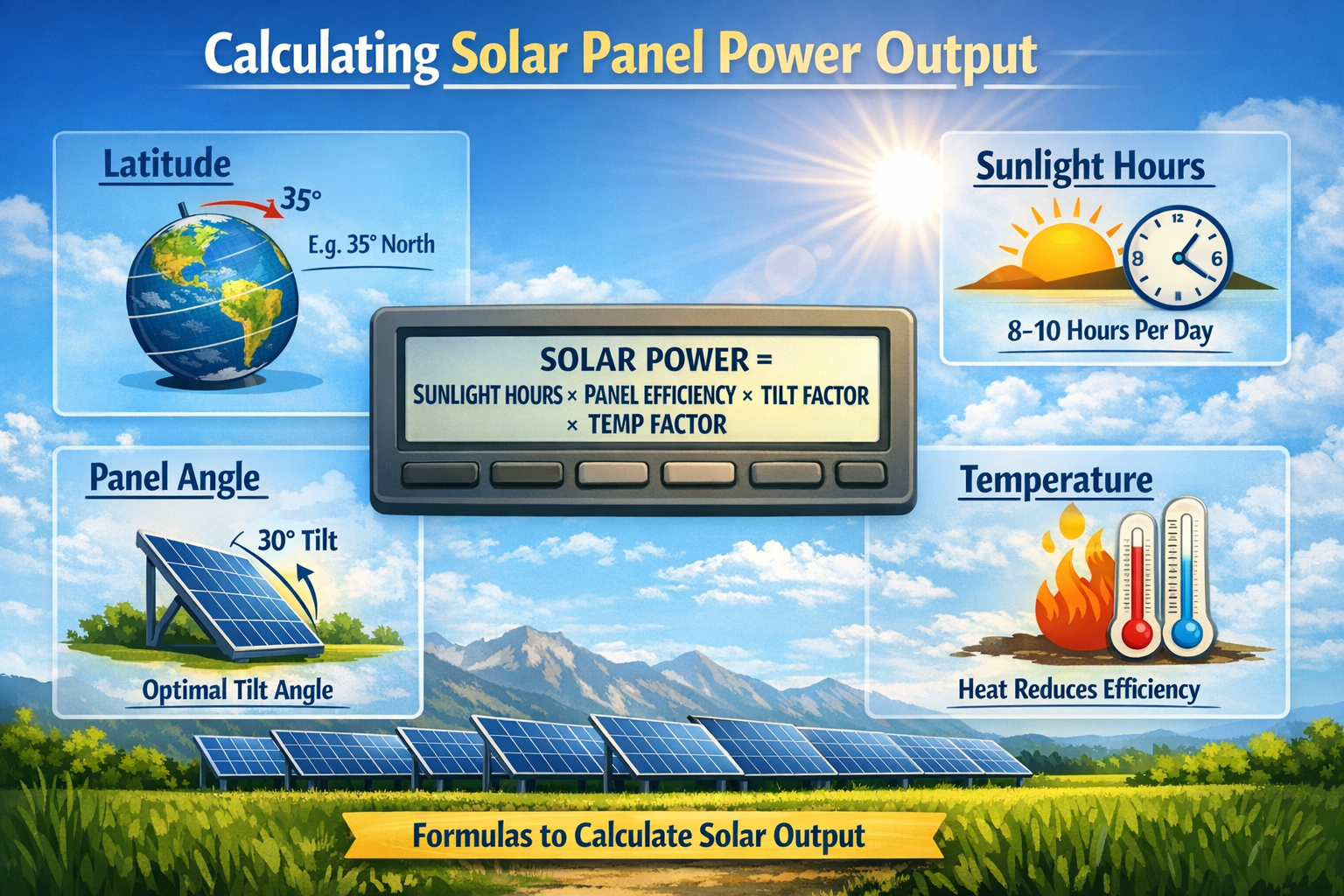
📐 L’équation fondamentale de la production solaire
Une formule largement utilisée pour estimer la production énergétique d’une installation photovoltaïque (PV) le système est le suivant [1]:
Cependant, pour mieux intégrer vos variables spécifiques, nous pouvons développer cela sous une forme plus détaillée, couramment utilisé pour le dimensionnement du système et mis en œuvre dans des modèles reconnus comme PVWatts de NREL [4]:
Définissons chaque terme dans cette équation développée [4, 8]:
- PPV : La production énergétique totale (en kWh) sur une période donnée (par exemple, tous les jours, mensuel, ou annuellement) ou la puissance de sortie (en W) [4].
- Pstc : La puissance nominale totale de votre panneau solaire (en kWcc) dans des conditions de test standard (ITS: irradiation de 1000 W/m², température des cellules de 25°C) [1, 4]. C'est le “taille” de votre système.
- Hinclinaison : Le quotidien, mensuel, ou irradiation solaire annuelle (en kWh/m²) sur le plan de votre panneau solaire (Plan de réseau ou POA). C'est ici latitude et angle du panneau sont utilisés pour calculer la lumière du soleil que votre configuration spécifique reçoit [5, 7].
- fatemp. : Le facteur de déclassement en température (une décimale entre 0 et 1). Cela explique la perte d’efficacité lorsque la température des cellules du panneau solaire dépasse 25°C. [1, 2, 8].
- faautre : Un facteur combiné pour toutes les autres pertes du système (une décimale entre 0 et 1). Cela inclut les salissures (poussière), ombres, pertes de câblage, efficacité de l'onduleur, et plus [1, 4].
🔍 Décomposer les composants clés
Pour faire fonctionner cette équation, vous devez déterminer les valeurs spécifiques pourHticometfatetmp.
1. Irradiation sur une surface inclinée ()
C'est la partie la plus complexe, car il combine votre emplacement (latitude) et angle du panneau. L'angle d'inclinaison fixe optimal annuel pour un emplacement est souvent approximé par sa latitude [5]. Cependant, pour une précision maximale, une approche plus nuancée est nécessaire.
- Angle d'inclinaison fixe: La “règle d'or” est de régler l'angle d'inclinaison égal à votre latitude. Par exemple, à une latitude de 35°N, les panneaux sont souvent installés avec une inclinaison de 35° [5].
- Calculateur Hinclinaison: Calculer manuellement l'irradiation sur un plan incliné est complexe. Cela nécessite de diviser les données de rayonnement solaire horizontal en composantes directes et diffuses, puis de les transposer sur le plan incliné. [7]. Pour cette raison,, les professionnels utilisent des outils comme celui de la Commission européenne PVGIS (Système d'Information Géographique Photovoltaïque) [3] ou NREL Watts photovoltaïques aux États-Unis [4]. En saisissant votre emplacement (latitude/longitude), inclinaison du panneau, et orientation (azimut), ces outils fournissent une valeur précise pour Inclinaison. Des approches plus récentes utilisent même l'apprentissage automatique pour améliorer la précision de ces estimations par rapport aux modèles isotropes traditionnels. [7].
2. Le facteur de déclassement de la température (fatetmp)
Les panneaux solaires fonctionnent moins efficacement à mesure qu’ils chauffent. Ce facteur corrige cet effet [1, 2]. La formule, implémenté dans des modèles comme PVWatts, est comme suit [4, 8]:
- c : Le coefficient de température de puissance fourni par le constructeur. Pour le silicium cristallin, il est généralement exprimé en %/° C et est négatif [6, 10].
- Tcellule : La température estimée de la cellule de fonctionnement (° C). Des modèles plus sophistiqués tiennent également compte de la vitesse du vent et de l'irradiation. [1, 9].
- Tstc : La température de la cellule dans des conditions de test standard (ITS), ce qui est toujours 25° C [4].
Par exemple, selon les données de l'industrie, pour un module avecc=−0,4%/°C, Cellule T=65°C, etTstc=25°C, la perte de puissance est importante [6]. Le calcul est:
Cela signifie que le panneau fonctionne uniquement à 84% de sa puissance nominale en raison de la température élevée.
Coefficient de température typique (c) Valeurs
Le tableau ci-dessous présente les valeurs typiques pour différentes technologies de panneaux, basé sur des données de recherche et de l'industrie [2, 6, 10]:
| Technologie des panneaux | Coefficient de température typique (c) | Remarques |
|---|---|---|
| Silicium monocristallin (BSF plus âgé) | -0.45% à -0.50% /° C | Technologie plus ancienne avec des pertes de température plus élevées [6]. |
| Silicium monocristallin (MINUTE moderne) | -0.35% à -0.40% /° C | Technologie commune avec des performances améliorées [6]. |
| Silicium monocristallin (TOPCon de type N) | -0.29% à -0.35% /° C | Une technologie avancée avec un très bon coefficient [6]. |
| Silicium monocristallin (HJT – Hétérojonction) | -0.25% à -0.30% /° C | Une technologie premium avec le meilleur coefficient [6]. |
| Silicium polycristallin | -0.40% à -0.50% /° C | Technologie plus ancienne, coefficient généralement plus élevé [6]. |
| Film mince (CdTe) | -0.24% à -0.25% /° C | Très bonne tenue en chaleur [6]. |
| Modules vieillis sur le terrain | -0.5% /° C (pour ηm) | Des mesures sur des modules vieillis confirment ces ordres de grandeur [2]. |
3. Autres facteurs de déclassement (falathest)
Il s’agit d’un fourre-tout pour les inefficacités du monde réel. Une valeur typique pour un système bien conçu pourrait être d'environ0.75 à 0.85 [1]. Vous pouvez le calculer en multipliant des facteurs individuels ensemble [4].
💡 Un exemple pratique
Combinons-les pour une estimation annuelle simplifiée pour un1 système kWcc en utilisant la formule PVWatts [4, 8].
- Puissance du réseau (Pstc): 1 kWcc
- Irradiation inclinée (Hinclinaison): Supposons que vous ayez utilisé un outil en ligne comme PVGIS [3] pour votre latitude spécifique et l'inclinaison choisie. L'outil génère un annuel Hinclinaison de 1700 kWh/m².
- Facteur de température (fatemp.): En fonction de votre climat local et des spécifications des panneaux (par exemple, c=−0,4%/°C [6]), vous calculez une moyenne annuelle fttempde 0.90.
- Autres pertes (faautre): Vous estimez un facteur combiné de 0.80 pour les pertes de l'onduleur, salissure, câblage, etc. [1, 4].
Votre production énergétique annuelle estimée (Ppdans) serait [4]:Ppdans=1 kWcc×1700 kWh/m²×0,90×0,80=1224 kWh
Cela signifie que votre 1 Le système kWdc devrait générer environ 1224 kWh d'électricité par an dans ces conditions.
🧠 Recommandations pour les résultats les plus précis
- Utilisez des outils professionnels: Pour le plus fiable valeurs, Je recommande fortement d'utiliser des outils établis comme PVGIS [3] ou Watts photovoltaïques [4]. Ils gèrent pour vous la géométrie complexe de la position du soleil et de la conversion du rayonnement. [7].
- Consultez la fiche technique: La valeur la plus précise pour le coefficient de température (c) proviendra toujours de la fiche technique du fabricant pour le modèle de panneau solaire spécifique que vous utilisez [6, 10]. Rechercher “Coefficient de température de Pmax” ou “Coefficient de température de puissance”.
- Recueillir des données d'entrée de qualité: La précision de votre équation dépend de vos entrées. Utilisez les données spécifiques au site pour les températures moyennes et les détails techniques exacts de vos panneaux [1, 2, 9].
📚 Liste de référence
[1] MDPI (2022). Équation implicite pour la température et l'efficacité des modules photovoltaïques via un modèle informatique de transfert de chaleur.MDPI
[2] NIH (2023). Table 3: Coefficients de température moyens du 3 modules photovoltaïques vieillis sur le terrain.Hélion
[3] Scilit (sans date). PV-SIG: une base de données Web sur le rayonnement solaire pour le calcul du potentiel photovoltaïque en Europe.Scilit
[4] NREL (2013). Version PVWatts 1 Référence technique.Laboratoire national des énergies renouvelables (NREL)
[5] Visage câlin (sans date). Fiacre/PV-system-expert-500 · Ensembles de données.Visage câlin
[6] Tongwei (2025). Efficacité du panneau solaire mono-silicium 丨 Coefficient de température, Performances en basse lumière, Taux d'atténuation.Tongwei Co., Ltd.
[7] Conversion et gestion de l'énergie (2024). Un outil universel pour estimer le rayonnement solaire mensuel sur des surfaces inclinées à partir de mesures horizontales: Une approche d’apprentissage automatique.Conversion et gestion de l'énergie
[8] Documentation pvlib-python (sans date). pvlib.pvsystem.pvwatts_dc.Lire les documents
[9] Bibliothèque numérique de l'UNT (1981). Etudes analytiques et expérimentales de systèmes combinés photovoltaïques/thermiques. Rapport d'état technique Non. 12. Université du nord du Texas
[10] IEEE (1997). Coefficients de température pour les modules et panneaux photovoltaïques: méthodes de mesure, problèmes, et les résultats.Compte rendu de la vingt-sixième conférence des spécialistes du photovoltaïque de l'IEEE