
Passive vs. Active Harmonic Filter in a Data Center: A Field Comparison — Mirus International
| Facility | Data center — Canadian financial institution, Barrie, Ontario |
| Testing commission | ADM Engineering / Mirus International — July 2012 |
| Test conditions | Diesel generator backup supply (worst-case weak source) |
| Passive filter loads | Chilled water pumps — 430 HP total, Lineator AUHF on each VSD |
| Active filter load | 227 HP chiller — built-in parallel active harmonic filter |
| Passive result — THDv | 0.4% |
| Passive result — THDi | 8% |
| Active result — THDi (full load) | > 12% |
| Active result — THDi (reduced load) | > 15% |
| IEEE 519 compliance | Passive: Yes. Active: No. |
01 Operating Context: VSDs in Data Centers and the Harmonic Consequence
Data centers are among the largest electrical energy consumers in the commercial sector, and they have been a primary target for energy efficiency programs for over a decade. Variable speed drives have become increasingly common in data center cooling infrastructure — chillers, chilled water pumps, cooling tower fans, and computer room air conditioners (CRACs) all benefit from variable speed operation, which reduces motor energy consumption dramatically at partial load compared to fixed-speed alternatives.[1]
The energy efficiency benefit of VSDs is real and substantial. But a VSD is a 6-pulse non-linear load that injects harmonic currents into the supply network. In a data center with multiple large VSDs on the cooling system, the cumulative harmonic loading can be significant — and data center loads are among the most sensitive to voltage distortion. Server power supplies, UPS systems, and precision cooling controls all perform better on clean power.
At a new data center for a Canadian financial institution in Barrie, Ontario, two harmonic mitigation approaches were deployed on the cooling system: Mirus Lineator AUHF passive filters on all chilled water pump drives, and a built-in parallel active harmonic filter on the 227 HP chiller. In July 2012, Mirus International was engaged by ADM Engineering to conduct a comparative field evaluation of both approaches under worst-case conditions.[1]
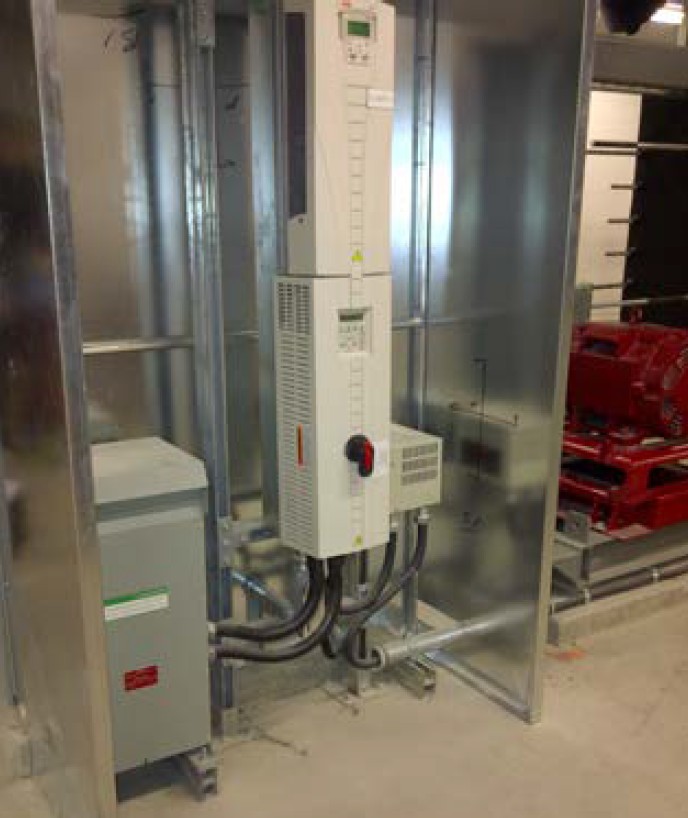
Fig. 1. Lineator AUHF and VSD installation on a chilled water pump at the Barrie data center. Lineators were applied to all chilled water pump drives totalling 430 HP. Source: Mirus International.[1]
02 The Active Filter Result: Surprisingly Poor Performance
2.1 How parallel active harmonic filters work
A shunt-type parallel active harmonic filter connects in parallel with the non-linear load it is mitigating. It continuously measures the load current, extracts the harmonic content using digital signal processing, and injects an equal and opposite harmonic current into the supply circuit — cancelling the load’s harmonic current at the point of connection. In principle, this is a complete and adaptive harmonic cancellation approach — unlike passive filters, it does not depend on tuned resonance and it responds to changing harmonic content in real time.[2]
In practice, the performance depends critically on the accuracy and bandwidth of the current sensing, the speed and precision of the IGBT switching that generates the compensation current, and the bandwidth of the control loop. These limitations become apparent in field measurements — particularly at higher harmonic orders and under varying load conditions.
2.2 Measured results: active filter on the chiller
At full chiller load, the built-in active harmonic filter produced measured current THDi exceeding 12%. This is a surprisingly poor result for a technology marketed specifically for harmonic mitigation. When chiller load was reduced, performance degraded further — THDi exceeded 15% at reduced load conditions, with high-frequency harmonic components clearly visible in the current waveform.[1]
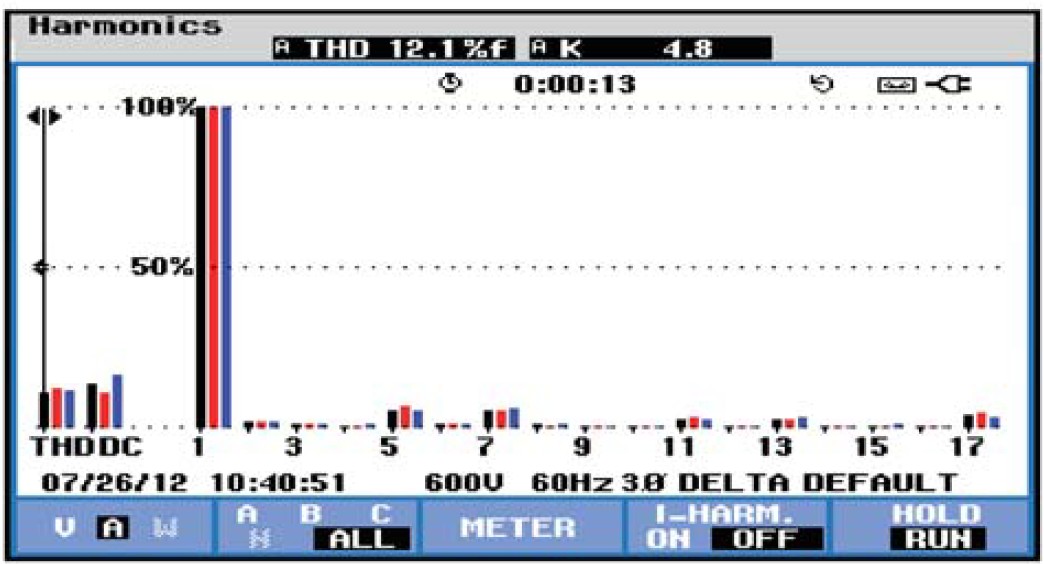
Fig. 2a. Chiller active harmonic filter — full load. THDi = 12.1%. High-frequency harmonic components visible in spectrum. Source: Mirus International.[1]
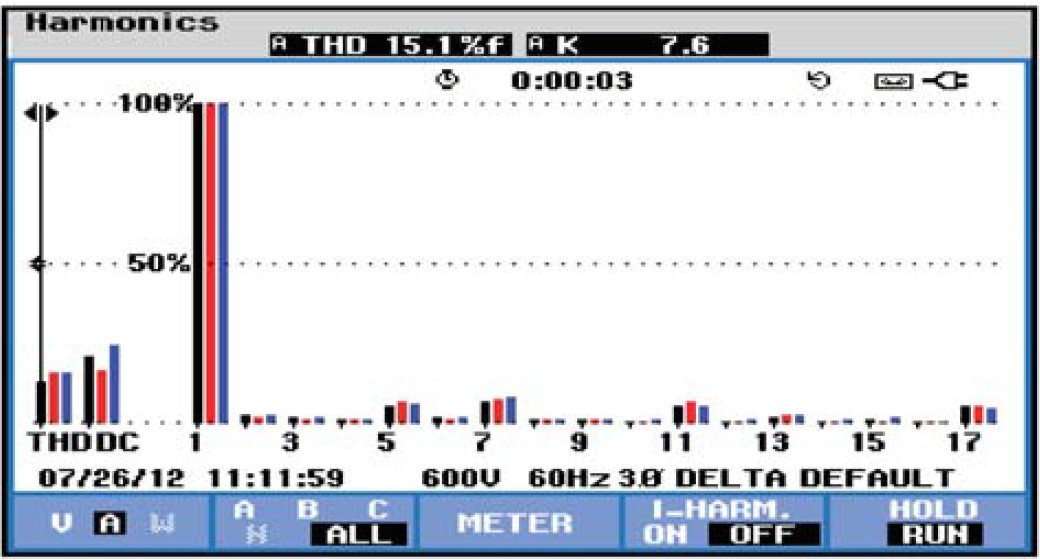
Fig. 2b. Chiller active harmonic filter — reduced load. THDi = 15.1%. Performance degrades at partial load — the opposite of what a data center cooling application requires. Source: Mirus International.[1]
2.3 Why active filters degrade at light load
The degradation of active filter performance at reduced load is a characteristic of the technology. At full load, the harmonic currents are large relative to the fundamental, making them easier to sense accurately and cancel effectively. At reduced load, the fundamental current is smaller, the harmonic currents are smaller in absolute terms, and the signal-to-noise ratio of the current sensing decreases. The control loop accuracy deteriorates, compensation becomes less precise, and residual harmonic content — plus the filter’s own IGBT switching harmonics — dominates the THDi measurement. This is the opposite of what is needed in a data center cooling system, where loads vary continuously over a wide range.
03 The Passive Filter Result: IEEE 519 Compliance Under Generator Supply
The chilled water pump drives — all equipped with Mirus Lineator AUHF passive filters — were measured next under the same diesel generator supply conditions. The results were markedly different from the active filter measurements:[1]
- Voltage THDv at pump input terminals: 0.4%
- Current THDi at pump input terminals: 8%
Both values are well within IEEE 519 limits. The 0.4% THDv is an exceptionally clean result — even on a utility supply it would be considered excellent. Achieving it under diesel generator supply, where source impedance is high and voltage distortion would be expected to be worse than on the utility grid, demonstrates that the Lineator’s harmonic attenuation is effective even under the most challenging source conditions.[1]
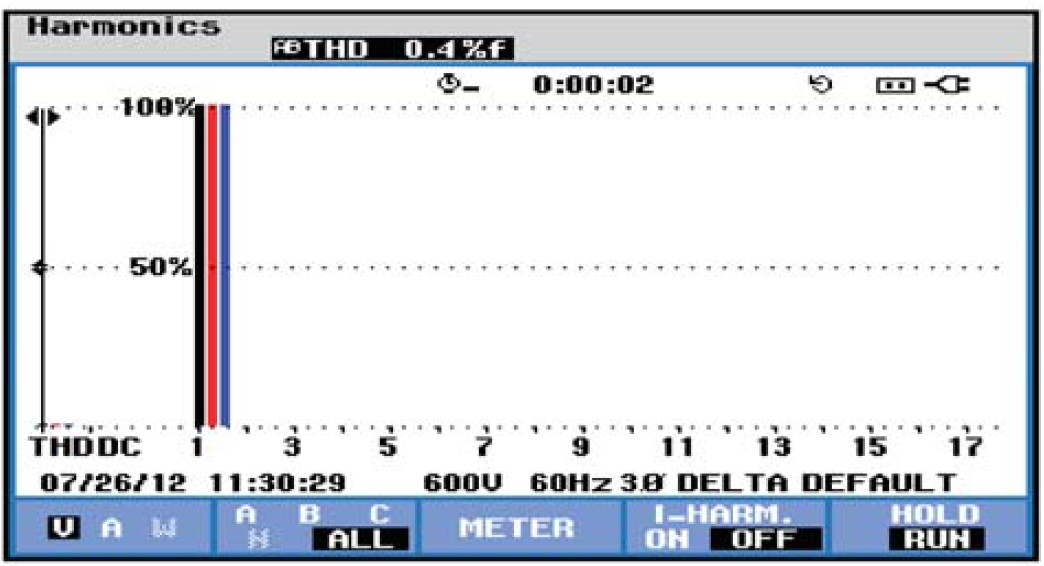
Fig. 3a. Chilled water pump with Lineator AUHF — voltage distortion. THDv = 0.4%. Measured under diesel generator supply. Source: Mirus International.[1]
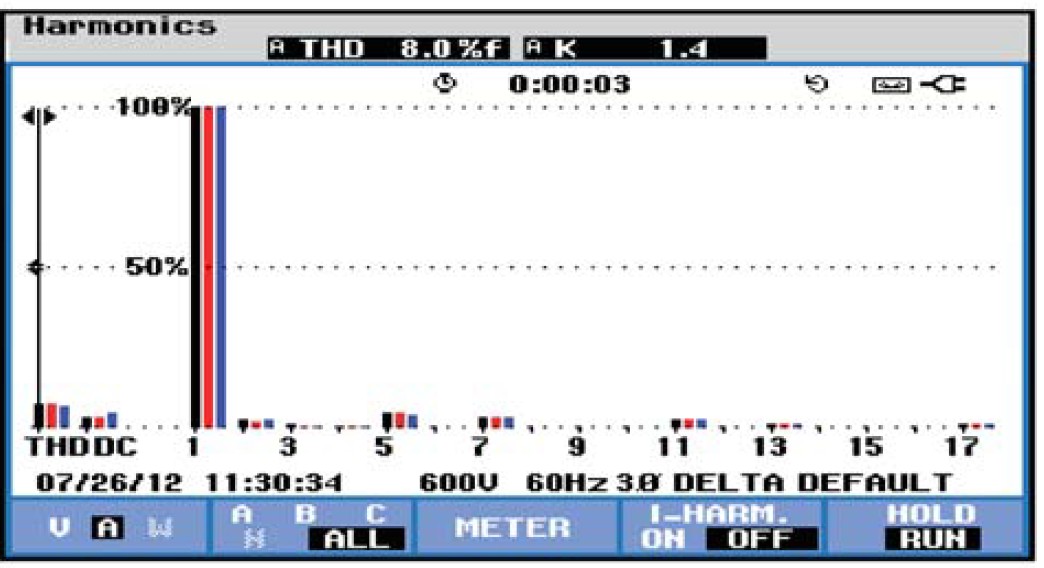
Fig. 3b. Chilled water pump with Lineator AUHF — current distortion. THDi = 8.0%. IEEE 519 compliant under worst-case generator supply. Source: Mirus International.[1]
The Lineator AUHF capacitive reactive current at light load was measured at less than 15% of rated current — well within the acceptable operating range for the data center’s diesel generators. This is an important generator compatibility check: passive filters with large capacitor banks can cause leading power factor conditions that destabilize generator AVR systems. The Lineator’s low capacitive reactive content avoids this problem, as was also demonstrated in the generator-fed case studies earlier in this series.
04 Head-to-Head: Passive vs. Active in the Same Facility
| Parameter | Chiller — Active filter (built-in) | Chilled water pumps — Passive Lineator AUHF |
|---|---|---|
| THDi — full load | > 12% | 8% |
| THDi — reduced load | > 15% | 8% (consistent) |
| THDv at terminals | Not specified | 0.4% |
| High-frequency noise | Present — IGBT switching artefacts | None — no active switching components |
| IEEE 519 compliance | No | Yes |
| Generator compatibility | Unknown — high-frequency noise risk | Confirmed — <15% capacitive reactive at light load |
| Performance vs. load | Degrades at light load | Consistent across load range |
05 The Power Quality Perspective: What This Case Study Illustrates
5.1 Data centers as a PQ-sensitive environment
Data centers present a unique combination of harmonic source and harmonic victim in the same facility. The cooling system VSDs are harmonic sources. The IT equipment — servers, storage, networking — contains switching power supplies that are themselves non-linear loads, and these power supplies are sensitive to supply voltage quality. A data center with poor internal power quality is harming its own critical loads.
The IEEE 519 standard’s limits at the point of common coupling protect the utility network and neighbouring customers. Within the data center’s internal distribution, the relevant concern is whether voltage distortion from the cooling system VSDs affects IT equipment performance and reliability. The 0.4% THDv achieved with the Lineator AUHF under generator supply is essentially negligible — it imposes no measurable stress on downstream IT equipment power supplies.
5.2 The active filter’s failure modes — a technology assessment
Active harmonic filters are marketed on the basis of adaptability — they respond to changing harmonic content in real time, unlike passive filters tuned to specific harmonic orders. This adaptability is real and genuinely valuable in some applications: systems where the harmonic spectrum changes unpredictably, or where many different types of loads share a common bus. However, the San Antonio and Barrie data center case studies together suggest that in specific, well-characterized VSD applications, a well-designed passive filter consistently matches or outperforms active alternatives at lower cost and with no IGBT switching noise side effects.
The light-load performance degradation observed in the active filter is particularly relevant for data center cooling applications, where cooling loads follow the IT load profile and spend significant time at partial load. A filter that performs worst precisely when the system runs lightly loaded is poorly matched to this application’s duty cycle.
5.3 Generator backup supply as a harmonic stress test
The decision to conduct testing under diesel generator backup supply — rather than on utility supply — is methodologically correct and worth noting. Data centers are designed for continuous operation through utility outages. During a generator-powered operating period, the harmonic environment is worse than normal. If harmonic mitigation is only verified on utility supply, there is no assurance that the system will remain within compliance during a generator-powered period — exactly when reliability is most critical.
This case study — the final in the Mirus International series presented on IPQDF — brings the collection full circle. The series opened with generator-fed oil field applications where harmonic problems caused equipment failures in remote, unmanned installations. It closes with a generator-tested data center evaluation at the opposite end of the infrastructure spectrum — mission-critical, urban, IT-intensive. The harmonic physics are identical in both environments. The consequence of getting it wrong is different in scale, not in kind.
References
- [1] Mirus International Inc., “Lineator Case Study: Passive harmonic filter vs. Active filter in a data center,” Application Case Study, Brampton, Ontario, Canada, 2012. Available: mirusinternational.com
- [2] IEEE Std 519-2022, “IEEE Standard for Harmonic Control in Electric Power Systems,” IEEE, New York, NY, 2022.