
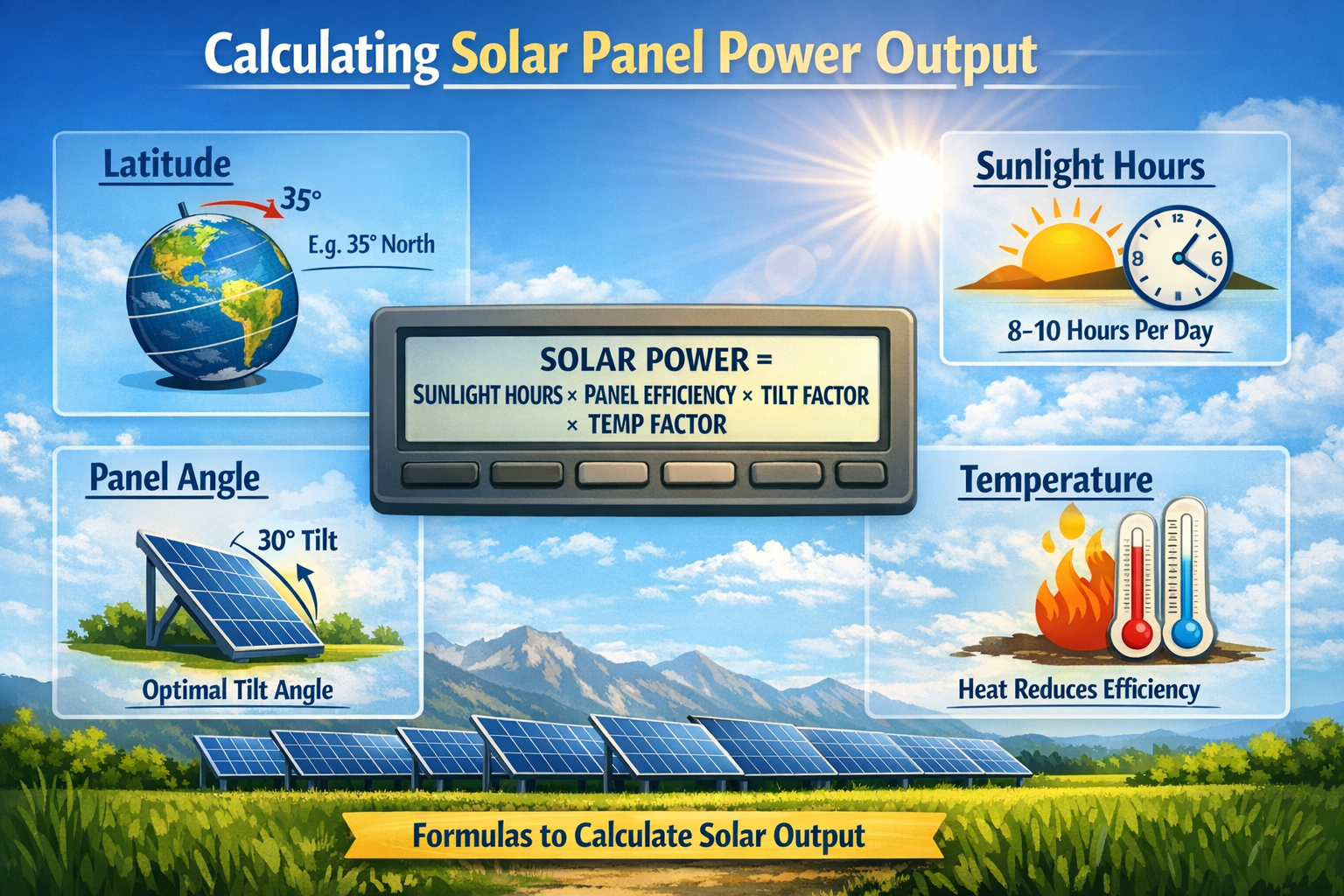
📐 La ecuación fundamental de la producción solar
Una fórmula ampliamente utilizada para estimar la producción de energía de una instalación fotovoltaica. (PV) el sistema es el siguiente [1]:
Sin embargo, para integrar mejor sus variables específicas, Podemos ampliar esto a una forma más detallada., comúnmente utilizado para dimensionar sistemas e implementado en modelos reconocidos como PVWatts de NREL [4]:
Definamos cada término en esta ecuación ampliada. [4, 8]:
- Ppv : La producción total de energía (en kWh) durante un periodo determinado (por ejemplo, a diario, mensual, o anualmente) o la potencia de salida (en W) [4].
- Pstc : La potencia nominal total de su panel solar (en kWdc) bajo condiciones de prueba estándar (STC: irradiancia de 1000 W/m², temperatura de la celda de 25°C) [1, 4]. Este es el “tamaño” de su sistema.
- Hinclinación : el diario, mensual, o irradiación solar anual (en kWh/m²) en el plano de su panel solar (Plano de matriz o POA). Aquí es donde latitud y ángulo del panel se utilizan para calcular la luz solar que recibe su configuración específica [5, 7].
- Ftemperatura : El factor de reducción de temperatura (un decimal entre 0 y 1). Esto explica la pérdida de eficiencia a medida que la temperatura de la celda del panel solar supera los 25°C. [1, 2, 8].
- Fotro : Un factor combinado para todas las demás pérdidas del sistema. (un decimal entre 0 y 1). Esto incluye suciedad (polvo), sombreado, pérdidas de cableado, eficiencia del inversor, y más [1, 4].
🔍 Desglosando los componentes clave
Para hacer que esta ecuación funcione, es necesario determinar los valores específicos paraHtyoltyFtymp.
1. Irradiación sobre una superficie inclinada ()
Esta es la parte más compleja., ya que combina tu ubicación (latitud) y ángulo del panel. El ángulo de inclinación fijo óptimo anual para una ubicación a menudo se aproxima por su latitud. [5]. Sin embargo, para máxima precisión, se necesita un enfoque más matizado.
- Ángulo de inclinación fijo: La “regla de oro” es establecer el ángulo de inclinación igual a su latitud. Por ejemplo, en una latitud de 35°N, Los paneles a menudo se instalan con una inclinación de 35°. [5].
- Calculador Hinclinación: Calcular manualmente la irradiación en un plano inclinado es complejo. Requiere dividir los datos de radiación solar horizontal en sus componentes directa y difusa y luego transponerlos al plano inclinado. [7]. Por esta razón, Los profesionales utilizan herramientas como la de la Comisión Europea. PVGIS (Sistema de Información Geográfica Fotovoltaica) [3] o NREL Vatios fotovoltaicos en los estados unidos [4]. Al ingresar su ubicación (latitud/longitud), inclinación del panel, y orientación (azimut), Estas herramientas proporcionan un valor preciso para inclinación. Los enfoques más recientes incluso utilizan el aprendizaje automático para mejorar la precisión de estas estimaciones en comparación con los modelos isotrópicos tradicionales. [7].
2. El factor de reducción de temperatura (Ftymp)
Los paneles solares funcionan menos eficientemente a medida que se calientan. Este factor corrige este efecto. [1, 2]. la formula, implementado en modelos como PVWatts, es el siguiente [4, 8]:
- do : El coeficiente de temperatura de potencia proporcionado por el fabricante.. Para silicio cristalino, normalmente se expresa en %/°C y es negativo [6, 10].
- Tcelular : La temperatura operativa estimada de la celda (°C). Los modelos más sofisticados también tienen en cuenta la velocidad del viento y la irradiancia. [1, 9].
- Tstc : La temperatura de la celda en condiciones de prueba estándar. (STC), que es siempre 25°C [4].
Por ejemplo, según datos de la industria, para un módulo condo=-0,4%/°C, Tcelda=65°C, ytstc=25°C, la pérdida de potencia es significativa [6]. El cálculo es:
Esto significa que el panel está funcionando solo a 84% de su potencia nominal debido a la alta temperatura.
Coeficiente de temperatura típico (do) Valores
La siguiente tabla presenta valores típicos para diferentes tecnologías de paneles., basado en investigaciones y datos de la industria [2, 6, 10]:
| Tecnología de paneles | Coeficiente de temperatura típico (do) | Notas |
|---|---|---|
| Silicio monocristalino (BSF más antiguo) | -0.45% a -0.50% /°C | Tecnología más antigua con mayores pérdidas de temperatura [6]. |
| Silicio monocristalino (MINUTO moderno) | -0.35% a -0.40% /°C | Tecnología común con rendimiento mejorado [6]. |
| Silicio monocristalino (TOPCon tipo N) | -0.29% a -0.35% /°C | Tecnología avanzada con un muy buen coeficiente. [6]. |
| Silicio monocristalino (HJT – heterounión) | -0.25% a -0.30% /°C | Tecnología premium con el mejor coeficiente [6]. |
| Silicio policristalino | -0.40% a -0.50% /°C | Tecnología más antigua, coeficiente generalmente más alto [6]. |
| Película delgada (CdTe) | -0.24% a -0.25% /°C | Muy buen comportamiento en calor. [6]. |
| Módulos envejecidos en el campo | -0.5% /°C (para ηm) | Las mediciones realizadas en módulos antiguos confirman estos órdenes de magnitud [2]. |
3. Otros factores de reducción (Flathes)
Este es un comodín para las ineficiencias del mundo real.. Un valor típico para un sistema bien diseñado podría ser alrededor0.75 a 0.85 [1]. Puedes calcularlo multiplicando factores individuales. [4].
💡 Un ejemplo práctico
Combinemos estos para obtener una estimación anual simplificada para un1 sistema kWdc usando la fórmula PVWatts [4, 8].
- Potencia de matriz (Pstc): 1 kWdc
- Irradiación inclinada (Hinclinación): Supongamos que ha utilizado una herramienta en línea como PVGIS. [3] para su latitud específica y la inclinación elegida. La herramienta genera un anual Hinclinación de 1700 kWh/m².
- Factor de temperatura (Ftemperatura): Según el clima local y las especificaciones del panel (por ejemplo, do=-0,4%/°C [6]), se calcula un promedio anual ftemp de 0.90.
- Otras pérdidas (Fotro): Se estima un factor combinado de 0.80 para pérdidas del inversor, ensuciamiento, alambrado, etc. [1, 4].
Su producción energética anual estimada (Ppen) sería [4]:Ppen=1 kWdc×1700 kWh/m²×0,90×0,80=1224 kWh
Esto significa que tu 1 Se espera que el sistema kWdc genere aproximadamente 1224 kWh de electricidad al año en estas condiciones.
🧠 Recomendaciones para obtener resultados más precisos
- Utilice herramientas profesionales: Para los más confiables valores, Recomiendo encarecidamente utilizar herramientas establecidas como PVGIS [3] o Vatios fotovoltaicos [4]. Ellos manejan la compleja geometría de la posición del sol y la conversión de radiación por usted. [7].
- Consultar la hoja de datos: El valor más preciso para el coeficiente de temperatura. (do) siempre provendrá de la hoja de datos del fabricante para el modelo de panel solar específico que esté utilizando [6, 10]. Buscar “Coeficiente de temperatura de Pmax” o “Coeficiente de temperatura de energía”.
- Reúna datos de entrada de calidad: La precisión de su ecuación depende de sus entradas. Utilice datos específicos del sitio para temperaturas promedio y los detalles técnicos exactos de sus paneles [1, 2, 9].
📚 Lista de referencias
[1] MDPI (2022). Ecuación implícita para la temperatura y eficiencia del módulo fotovoltaico mediante un modelo computacional de transferencia de calor.MDPI
[2] NIH (2023). Mesa 3: Coeficientes de temperatura promedio de la 3 módulos fotovoltaicos envejecidos en el campo.helio
[3] Scilit (sin fecha). FV-GIS: una base de datos de radiación solar basada en la web para el cálculo del potencial fotovoltaico en Europa.Scilit
[4] NREL (2013). Versión PVWatts 1 Referencia técnica.Laboratorio Nacional de Energías Renovables (NREL)
[5] abrazando la cara (sin fecha). Fiacre/PV-system-expert-500 · Conjuntos de datos.abrazando la cara
[6] tongwei (2025). Eficiencia del panel solar monosilicio 丨 Coeficiente de temperatura, Rendimiento con poca luz, Tasa de atenuación.Tongwei Co., Ltd.
[7] Conversión y gestión de energía (2024). Una herramienta universal para estimar la radiación solar mensual en superficies inclinadas a partir de mediciones horizontales.: Un enfoque de aprendizaje automático.Conversión y gestión de energía
[8] Documentación de pvlib-python (sin fecha). pvlib.pvsystem.pvwatts_dc.Lea los documentos
[9] Biblioteca Digital UNT (1981). Estudios analíticos y experimentales de sistemas combinados fotovoltaicos/térmicos.. Informe de situación técnica No. 12. Universidad del Norte de Texas
[10] IEEE (1997). Coeficientes de temperatura para módulos y matrices fotovoltaicos: métodos de medición, dificultades, y resultados.Acta de la vigésima sexta conferencia de especialistas fotovoltaicos del IEEE