
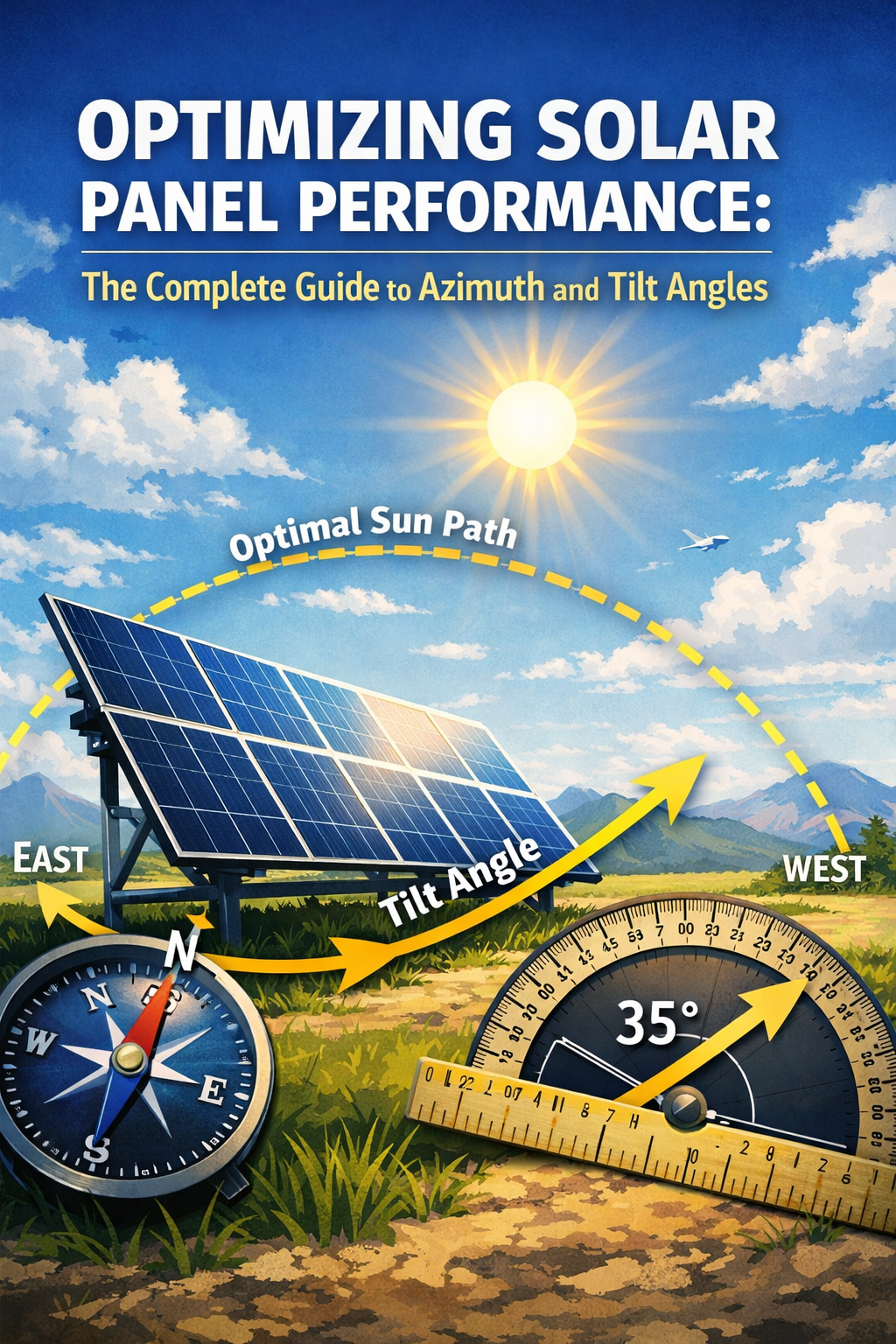
Para maximizar a produção de energia de um sistema de painel solar, dois ângulos críticos devem ser otimizados: oazimute (a direção da bússola para a qual o painel está voltado) e ainclinar (o ângulo vertical da horizontal). A configuração ideal é determinada principalmente pela latitude geográfica, mas também é influenciado pelos padrões de consumo de energia, restrições de telhado, e condições ambientais locais [1].
1. A Regra Cardeal: Azimute (Orientação)
O ângulo azimutal determina quando durante o dia um painel recebe mais luz solar.
- Hemisfério Norte: A regra de ouro é enfrentar os painéis em direçãoverdadeiro sul. Esta orientação captura a maior parte da luz solar à medida que o sol forma um arco na parte sul do céu [2]. Por exemplo, um estudo de otimização de um sistema em Nova Jersey descobriu que o azimute ideal era 176°, que fica quase ao sul [3].
- Hemisfério Sul: A regra é invertida; os painéis devem ficar voltadosnorte verdadeiro apontar para o equador [2].
Uma nota crítica sobre “Verdadeiro Sul”: É essencial orientar os painéis paraverdadeiro (geográfico) sul, nãomagnético sul conforme lido por uma bússola. A diferença, conhecida como declinação magnética, pode ser significativo e varia de acordo com o local [4].
Embora o sul seja o ideal teórico para a produção anual total máxima, existe uma flexibilidade significativa:
- Janela de flexibilidade: Desviando até15°–20° leste ou oeste do sul verdadeiro resulta em uma perda anual mínima de energia de apenas cerca de1% [5].
- Desempenho Leste/Oeste: Mesmo um telhado voltado para leste ou oeste ainda é viável, normalmente produzindo apenas10–23% menos energia anualmente do que um sistema voltado para o sul, dependendo da latitude [6].
2. A Fundação: Inclinar (Inclinação)
O ângulo de inclinação otimiza a captura de energia com base na altura do sol no céu, que muda com as estações.
- A regra de latitude para inclinação fixa: Para uma instalação fixa (sem ajustes sazonais), a prática recomendada padrão da indústria é definir o ângulo de inclinação igual à sua latitude [2]. Isto proporciona o melhor rendimento energético possível em média durante todo o ano. Uma fórmula de aproximação mais precisa sugerida para sistemas fixos é: Inclinação ideal ≈ latitude × 0.76 + 3.1° [3].
Ganhos Quantificados: O impacto da inclinação
Dados de um estudo de simulação usando o software SAM do NREL mostram claramente a importância de otimizar a inclinação. A tabela a seguir ilustra a produção anual de energia para um 3.4 sistema kW em dois EUA diferentes. cidades, demonstrando que o desempenho máximo ocorre em ângulos de inclinação estreitamente alinhados com suas respectivas latitudes [7].
| Ângulo de inclinação | Fênix, O (33°N) | Portland, OU (45°N) |
|---|---|---|
| 0° (Plano) | 5,723 kWh (Linha de base) | 3,624 kWh (Linha de base) |
| 20° | 6,461 kWh (+13%) | 4,239 kWh (+15%) |
| 30° | 6,575 kWh (+15%) | 4,355 kWh (+18%) |
| 40° | 6,526 kWh (+14%) | 4,368 kWh (+18%) |
| 90° (Vertical) | 3,966 kWh (-31%) | 2,967 kWh (-20%) |
- Ajuste sazonal: Para aqueles que desejam ajustar seus painéis duas vezes por ano, o desempenho pode ser ajustado. Uma estratégia comum é definir a inclinação paralatitude menos 10° a 15° no verão (quando o sol está alto) elatitude mais 10° a 15° no inverno (quando o sol está baixo). Isto pode render um ganho modesto de cerca de4–5% na produção anual de energia [3].
3. Combinando Azimute e Inclinação para Objetivos Específicos
Enquanto o “inclinação de latitude” e “verdadeiro azimute sul” regras maximizam a produção anual total, a configuração ideal pode mudar com base nas suas necessidades energéticas específicas.
- Maximizando a economia financeira: Se o seu utilitário tiver tempo de uso (TAMBÉM) tarifas onde a energia elétrica é mais cara no final da tarde, pode ser mais lucrativo orientar ligeiramente os painéisoeste do sul. Isso muda a produção mais tarde no dia, compensando a energia da rede mais cara, mesmo que a produção total de energia caia ligeiramente. A investigação mostra que a diferença máxima em poupanças financeiras entre uma orientação puramente optimizada em termos de energia e uma orientação optimizada em termos de receitas pode ser de até3.12% [8].
- Padrões de consumo correspondentes:
- Sudeste (135°): Melhor para residências com alto consumo de energia matinal [9].
- Sudoeste (225°): Ideal para residências com alto uso de ar condicionado à tarde ou com taxas TOU [9].
- Divisão Leste/Oeste: Em um telhado plano, colocar metade dos painéis a leste e metade a oeste pode criar uma área mais ampla, perfil de saída de energia mais consistente ao longo do dia, o que é excelente para maximizar o autoconsumo [10].
Tabela Resumo: Ângulos Recomendados por Hemisfério e Objetivo
| Meta | Hemisfério | Azimute (Direção) | Ângulo de inclinação | Principais considerações |
|---|---|---|---|---|
| Maximize a produção anual | Norte | Verdadeiro Sul (180°) | ≈Latitude | O padrão para o melhor ROI geral [2]. |
| Maximize a produção anual | Sul | Verdadeiro Norte (0°) | ≈Latitude | O padrão para o melhor ROI geral [2]. |
| Maximize a produção matinal | Norte | Sudeste (~135°) | ≈Latitude | Bom para residências com altas cargas matinais [9]. |
| Maximize a produção da tarde | Norte | Sudoeste (~225°) | ≈Latitude | Ideal para taxas de TOU e pico de uso de AC [9]. |
| Otimização sazonal | Qualquer | Sul (N. Bainha) / Norte (S. Bainha) | Latitude ± 15° | Requer ajuste manual duas vezes por ano para um ganho de aproximadamente 4% [3]. |
| Telhado não ideal | Qualquer | Leste ou Oeste | Inclinação do telhado existente | Viável; só 10-23% menos produção do que o ideal [6]. |
Ferramentas para precisão
Embora essas regras forneçam excelentes diretrizes, designers profissionais usam software avançado para otimização final. Ferramentas como NRELWatts fotovoltaicos, PVGIS, e outros usam dados meteorológicos específicos do local para simular a produção de energia em milhares de combinações de ângulos, contabilizando os padrões climáticos locais, sombreamento, e sujeira [1].
Gerado por IA sob supervisão de um adulto 😉
Referências
- Avaliações solares. (s.d.). Melhor ângulo do painel solar: Como encontrar o ângulo de inclinação. Obtido desolarreviews.com
- Solar.com. (s.d.). A melhor inclinação e orientação para painéis solares. Obtido desolar.com
- EnergySage. (s.d.). Qual é o melhor ângulo para painéis solares?. Obtido deenergysage.com
- Administração Nacional Oceânica e Atmosférica (NOAA). (s.d.). Declinação magnética. Obtido denoaa.gov
- Avaliações de energia limpa. (s.d.). Orientação do painel solar. Obtido decleanenergyreviews.info
- Energia Solar. (s.d.). Orientação do painel solar. Obtido desunpower.maxeon.com
- Laboratório Nacional de Energia Renovável (NREL). (s.d.). Modelo de consultor de sistema (SAM). Obtido denrel.gov
- ResearchGate. (2021). Otimização da orientação do arranjo fotovoltaico para taxas de tempo de uso. Obtido depesquisagate.net
- Tromba Verde. (s.d.). Direção e ângulo ideais para painéis solares. Obtido degreentumble. com
- SolarPowerWorldOnline. (s.d.). Orientação do painel solar Leste-Oeste. Obtido desolarpowerworldonline.com
Conteúdo elaborado com assistência de IA e validado pelo autor com base em 30 anos de experiência na área de Qualidade de Energia.