
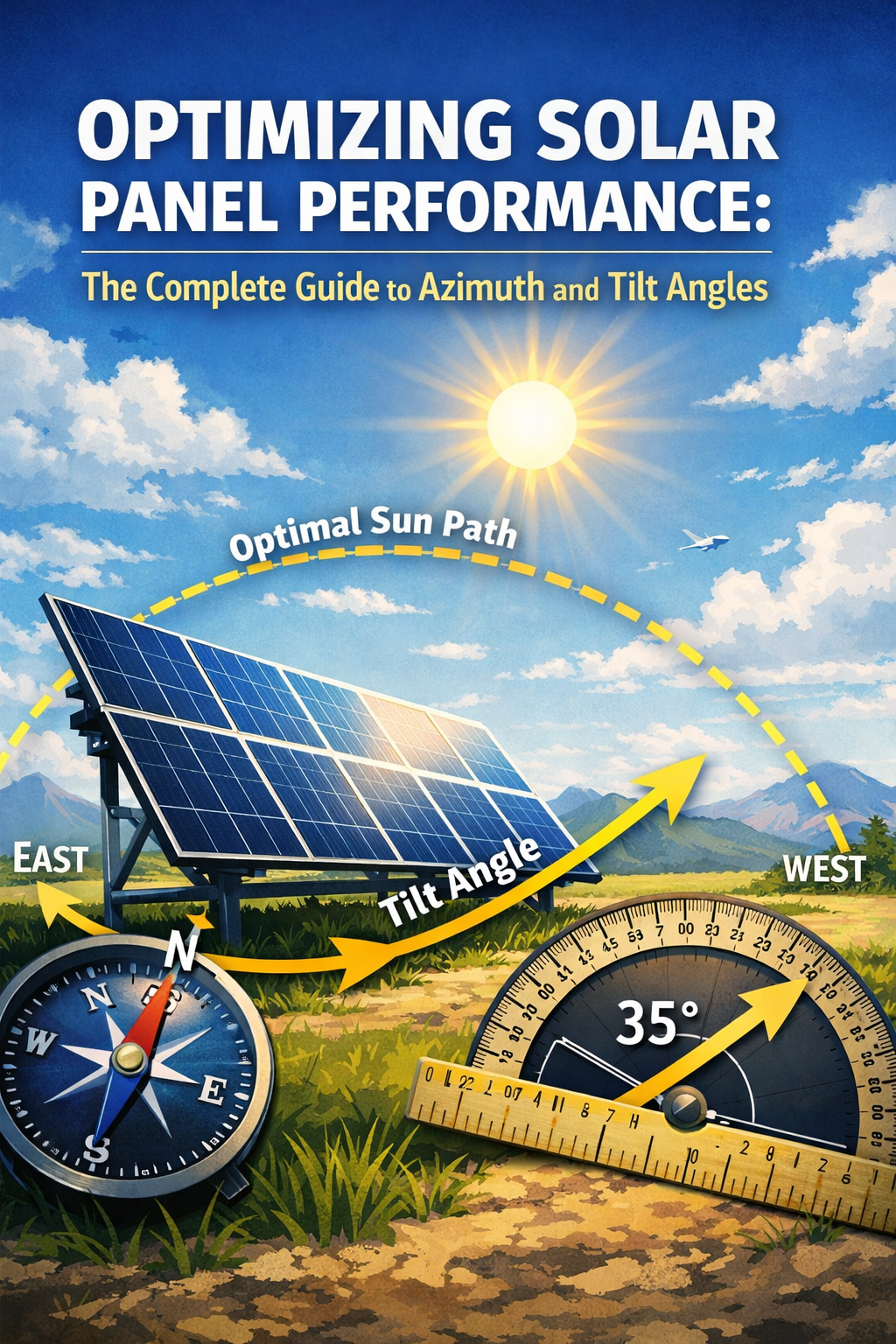
To maximize the energy output of a solar panel system, two critical angles must be optimized: laazimuth (the compass direction the panel faces) et l'tilt (the vertical angle from the horizontal). The ideal configuration is primarily determined by geographic latitude, but it is also influenced by energy consumption patterns, roof constraints, and local environmental conditions [1].
1. The Cardinal Rule: Azimuth (Orientation)
The azimuth angle dictates when during the day a panel receives the most sunlight.
- Northern Hemisphere: The golden rule is to face panels toward true south. This orientation captures the most sunlight as the sun arcs across the southern part of the sky [2]. Par exemple, a study optimizing a system in New Jersey found the ideal azimuth to be 176°, which is nearly due south [3].
- Southern Hemisphere: The rule is reversed; panels should face true north to point toward the equator [2].
A Critical Note on “True South”: It is essential to orient panels towardvrai (geographic) south, notmagnétique south as read by a compass. The difference, known as magnetic declination, can be significant and varies by location [4].
While due south is the theoretical optimum for maximum total yearly production, there is significant flexibility:
- Flexibility Window: Deviating up to 15°–20° east or west of true south results in a minimal annual energy loss of only about 1% [5].
- East/West Performance: Even a due-east or due-west facing roof is still viable, typically producing only 10–23% less energy annually than a south-facing system, depending on the latitude [6].
2. The Foundation: Tilt (Inclination)
The tilt angle optimizes energy capture based on the sun’s height in the sky, which changes with the seasons.
- The Latitude Rule for Fixed Tilt: For a fixed installation (no seasonal adjustments), the industry-standard best practice is to set the tilt angle equal to your latitude [2]. This provides the best possible energy yield averaged over the entire year. A more precise approximation formula suggested for fixed systems is: Optimal Tilt ≈ latitude × 0.76 + 3.1° [3].
Quantified Gains: The Impact of Tilt
Data from a simulation study using NREL’s SAM software clearly shows the importance of optimizing tilt. The following table illustrates the annual energy output for a 3.4 kW system in two different U.S. cities, demonstrating that maximum performance occurs at tilt angles closely aligned with their respective latitudes [7].
| Tilt Angle | Phoenix, AZ (33° N) | Portland, OR (45° N) |
|---|---|---|
| 0° (Flat) | 5,723 kWh (Baseline) | 3,624 kWh (Baseline) |
| 20° | 6,461 kWh (+13%) | 4,239 kWh (+15%) |
| 30° | 6,575 kWh (+15%) | 4,355 kWh (+18%) |
| 40° | 6,526 kWh (+14%) | 4,368 kWh (+18%) |
| 90° (Vertical) | 3,966 kWh (-31%) | 2,967 kWh (-20%) |
- Seasonal Adjustment: For those willing to adjust their panels twice a year, performance can be fine-tuned. A common strategy is to set the tilt to latitude minus 10° to 15° in the summer (when the sun is high) et latitude plus 10° to 15° in the winter (when the sun is low). This can yield a modest gain of about 4–5% in annual energy production [3].
3. Combining Azimuth and Tilt for Specific Goals
While the “latitude tilt” et “true south azimuth” rules maximize total annual output, the optimal configuration can shift based on your specific energy needs.
- Maximizing Financial Savings: If your utility has Time-of-Use (TOU) rates where electricity is more expensive in the late afternoon, it may be more profitable to orient panels slightly west of south. This shifts production later into the day, offsetting more expensive grid power even if total energy output drops slightly. Research shows that the maximum difference in financial savings between a pure energy-optimized orientation and a revenue-optimized orientation can be up to 3.12% [8].
- Matching Consumption Patterns:
- South-East (135°): Best for households with high morning energy consumption [9].
- South-West (225°): Ideal for homes with high afternoon air conditioning use or under TOU rates [9].
- East/West Split: On a flat roof, placing half the panels east and half west can create a broader, more consistent power output profile throughout the day, which is excellent for maximizing self-consumption [10].
Summary Table: Recommended Angles by Hemisphere and Goal
| Goal | Hemisphere | Azimuth (Direction) | Tilt Angle | Key Considerations |
|---|---|---|---|---|
| Maximize Annual Output | Northern | True South (180°) | ≈ Latitude | The standard for best overall ROI [2]. |
| Maximize Annual Output | Southern | True North (0°) | ≈ Latitude | The standard for best overall ROI [2]. |
| Maximize Morning Output | Northern | South-East (~135°) | ≈ Latitude | Good for homes with high morning loads [9]. |
| Maximize Afternoon Output | Northern | South-West (~225°) | ≈ Latitude | Ideal for TOU rates and peak AC usage [9]. |
| Seasonal Optimization | Either | South (N. Hem) / North (S. Hem) | Latitude ± 15° | Requires manual adjustment twice a year for a ~4% gain [3]. |
| Non-Ideal Roof | Either | East or West | Existing Roof Pitch | Viable; seulement 10-23% less output than optimal [6]. |
Tools for Precision
While these rules provide excellent guidelines, professional designers use advanced software for final optimization. Tools like NREL’sPVWatts, PVGIS, and others use site-specific meteorological data to simulate energy production across thousands of angle combinations, accounting for local weather patterns, shading, and soiling [1].
Generated by AI under adult supervision 😉
Références
- Solar Reviews. (n.d.). Best solar panel angle: How to find the tilt angle. Retrieved from solarreviews.com
- Solar.com. (n.d.). The best tilt and orientation for solar panels. Retrieved from solar.com
- EnergySage. (n.d.). What is the best angle for solar panels?. Retrieved from energysage.com
- National Oceanic and Atmospheric Administration (NOAA). (n.d.). Magnetic declination. Retrieved from noaa.gov
- Clean Energy Reviews. (n.d.). Solar panel orientation. Retrieved from cleanenergyreviews.info
- SunPower. (n.d.). Solar panel orientation. Retrieved from sunpower.maxeon.com
- Laboratoire national des énergies renouvelables (NREL). (n.d.). System Advisor Model (SAM). Retrieved from nrel.gov
- ResearchGate. (2021). Optimization of PV array orientation for time-of-use rates. Retrieved from researchgate.net
- Greentumble. (n.d.). Optimal direction and angle for solar panels. Retrieved from greentumble.com
- SolarPowerWorldOnline. (n.d.). East-West solar panel orientation. Retrieved from solarpowerworldonline.com