
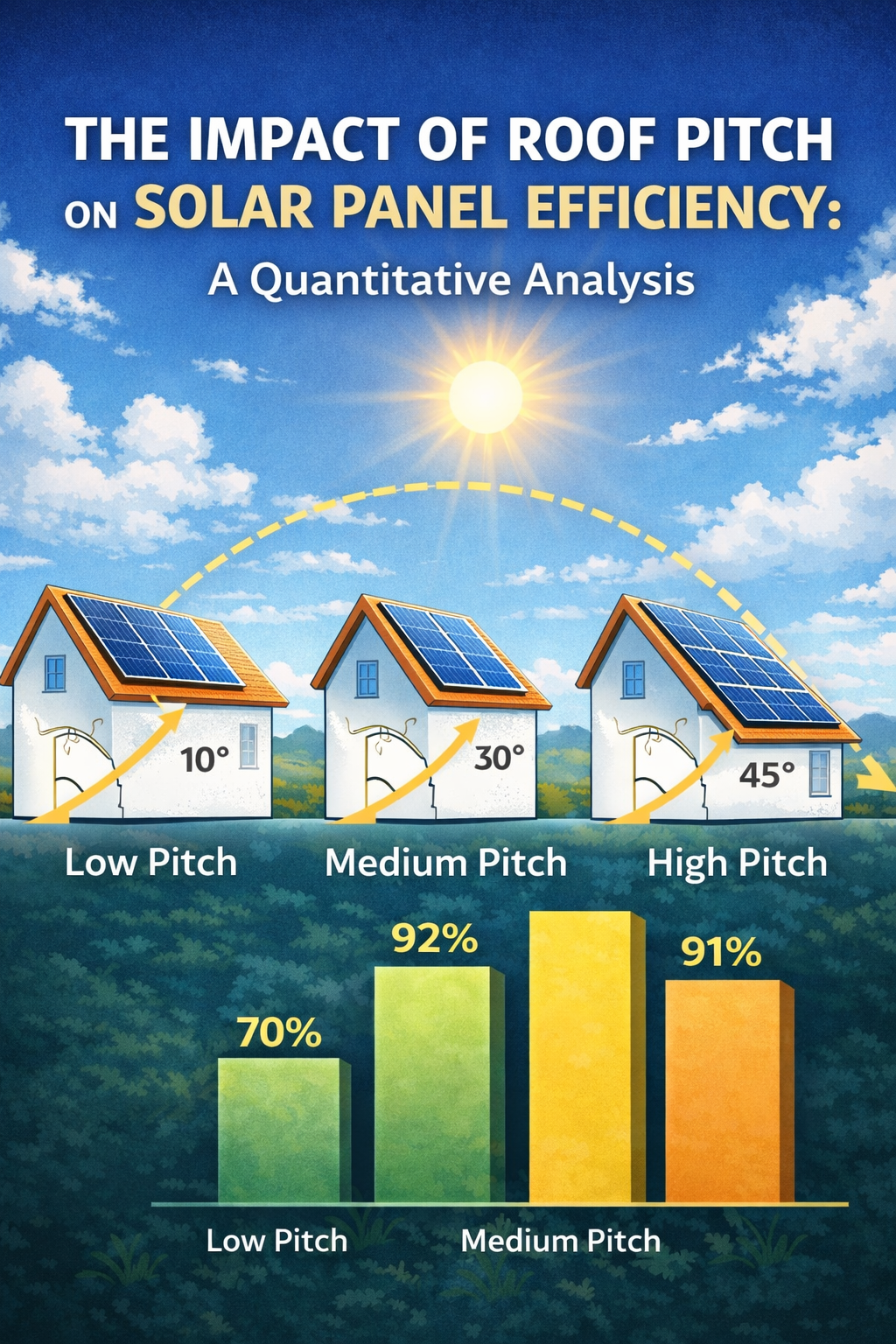
🌞 Introducción: The Geometry of Solar Energy Capture
The fundamental relationship between a solar panel’s orientation and its energy production is governed by basic principles of geometry and solar radiation. When sunlight strikes a panel at a perpendicular angle, the energy density is maximized, and the panel operates at its theoretical peak efficiency [1]. As the angle of incidence deviates from perpendicular, the same solar flux is distributed over a larger surface area, reducing the intensity of radiation per unit area and consequently decreasing power output [2].
For fixed-mounted photovoltaic systems, the objective is to identify the optimal tilt angle that maximizes annual energy capture. This optimal angle is primarily determined by geographic latitude, with the general rule suggesting that setting the tilt equal to the latitude optimizes year-round production [3]. Seasonal adjustments can be made by adding 10-15 degrees to favor winter production when the sun’s path is lower, or subtracting 10-15 degrees to enhance summer generation [4].
Sin embargo, residential and commercial rooftop installations face an inherent constraint: the existing roof pitch dictates the available tilt angle. This limitation introduces the critical question addressed in this analysis: how much power is lost when the roof angle deviates from the optimal tilt?
📐 The Mathematical Framework: Solar Radiation on Tilted Surfaces
To quantify the relationship between roof angle and power output, we must first establish the governing equations for solar radiation incident on an inclined surface. While comprehensive models account for diffuse sky radiation and ground-reflected components, the dominant factor is typically direct beam radiation [5].
A simplified expression relating radiation on a tilted module to that on a horizontal surface is given by:
Donde:
- = solar radiation on the tilted module (W/m²)
- = solar radiation on a horizontal surface (W/m²)
- α = solar elevation angle (degrees above horizon)
- β = module tilt angle from horizontal (degrees) [6]
This relationship can be derived by considering the radiation incident perpendicular to the sun’s rays ():
The objective of tilting panels is to maximize the term, thereby bringing the module surface closer to perpendicular alignment with the sun’s rays [7]. It is important to note that these equations typically represent conditions at solar noon when the sun reaches its maximum elevation. A complete annual analysis requires integrating these calculations over the sun’s entire daily and seasonal path [8].
⚖️ Quantifying Power Loss: Roof Angle Versus Optimal Tilt
When the actual roof angle () differs from the theoretically optimal tilt (), the resulting deviation directly reduces incident radiation and, consequently, annual energy production. Industry data and simulation studies provide quantifiable estimates of these losses.
According to the National Renewable Energy Laboratory (NREL), deviations of10 degrees from the optimal tilt can reduce annual energy production by approximately5% , while deviations of20 degrees may result in losses ranging from10% a 15% [9]. These findings align with practical observations from photovoltaic installation databases.
A detailed simulation study conducted for a location at 31° north latitude (comparable to Shanghai) examined the relationship between panel tilt and efficiency loss relative to the optimal 31° angle [10]:
| Panel Tilt Angle | Annual Efficiency Loss vs. Optimal (31°) |
|---|---|
| 5° | 3.6% |
| 15° | 0.8% |
| 25° | 0% |
| 30° | 0.5% |
| 40° | 2.7% |
Data adapted from photovoltaic performance simulations at 31° N latitude [10]
The practical implication of these findings is noteworthy: for deviations within a10-20 degree range of the optimum, the annual loss in power output is typically modest—between1% y 5% [11]. This explains why solar installers commonly accept tilt angles between 15° and 35° for locations near 30° latitude, as the marginal losses are economically justifiable compared to the cost of custom mounting structures [12].
The most significant penalties occur when panels are installed nearly flat or at extreme tilts far from the optimum. Por ejemplo, flush-mounting panels on a low-slope residential roof (22.5° pitch) where the optimal angle is 40° can result in annual losses of5-8% compared to an optimally tilted ground mount system [13].
🔍 Critical Factors Affecting Solar System Performance
While tilt angle is an important design parameter, it represents only one component of a complex optimization problem. Research indicates that other variables can exert equal or greater influence on final energy yield [14].
Orientation (Azimuth Angle)
In the northern hemisphere, optimal orientation is true south. Deviations from this azimuth introduce compounding losses when combined with suboptimal tilt. Simulations demonstrate that an array facing 30° off true south can experience total losses exceeding20% when tilt is also non-optimal. At 60° azimuth deviation, generation losses may reach20-30% annually [15].
Shading Effects
Partial shading represents one of the most significant threats to system performance. Even minimal shading on a single panel can trigger disproportionate losses across an entire string due to the electrical configuration of series-connected modules. Studies document shading-related efficiency reductions of10% o más in urban residential installations [16].
Installation Quality and Maintenance
Field studies reveal that practical installation factors substantially impact realized performance. Poor electrical connections, suboptimal inverter sizing, and voltage mismatch can collectively reduce system output. Además, soiling from dust and debris accumulation has been measured to decrease generation by up to5% in urban environments, with higher losses in arid or agricultural regions [17].
📊 Conclusión: Practical Implications for System Design
The relationship between roof pitch and solar panel efficiency is governed by well-established geometric principles expressed through solar radiation equations. While matching roof angle to optimal tilt theoretically maximizes production, the available data demonstrate that moderate deviations result in surprisingly modest annual losses—typically 1-5% for angles within 15-20° of the optimum.
These findings have practical implications for residential and commercial solar installations: the incremental benefit of achieving perfect tilt is often outweighed by the cost of custom racking systems, particularly when compared to flush-mounted installations on existing roof structures. A holistic approach to system design that optimizes orientation, minimizes shading, and ensures quality installation will yield greater long-term performance gains than pursuing perfect tilt angle at the expense of other factors [18].
This article was generated by AI under the supervision of an Adult 😉
📚 Referencias
[1] Duffie, J. A., & Beckman, En. La. (2013). Solar Engineering of Thermal Processes (4th ed.). John Wiley & Sons, pp. 12-15. [2] Masters, G. M. (2004). Renewable and Efficient Electric Power Systems. John Wiley & Sons, pp. 385-390. [3] National Renewable Energy Laboratory. (2021). “Solar Radiation Basics.” NREL Technical Report, Golden, CO. [4] Jacobson, M. Z., & Jadhav, En. (2018). “World estimates of PV optimal tilt angles and ratios of sunlight incident upon tilted and tracked PV panels relative to horizontal panels.” Energía solar, 169, pp. 55-66. [5] Liu, B. Y. H., & Jordania, R. C. (1963). “The long-term average performance of flat-plate solar-energy collectors.” Energía solar, 7(2), pp. 53-74. [6] Honsberg, C., & Bowden, S. (2019). “Photovoltaics Education Website.” PVEducation.org, Sección: “Solar Radiation on Tilted Surfaces.” [7] Messenger, R. A., & Ventre, J. (2010). Photovoltaic Systems Engineering (3rd ed.). CRC Press, pp. 45-49. [8] Lave, M., & Kleissl, J. (2011). “Optimum fixed orientations and benefits of tracking for capturing solar radiation in the continental United States.” Energías Renovables, 36(3), pp. 1145-1152. [9] National Renewable Energy Laboratory. (2020). “PVWatts Calculator: Methodology Documentation.” NREL/TP-6A20-6858, Golden, CO. [10] Sol, Y., y col. (2018). “Optimum tilt angle for photovoltaic systems in different climate zones.” Energy Procedia, 152, pp. 116-121. [11] Rowlands, Yo. H., Kemery, B. P., & Beausoleil-Morrison, Yo. (2011). “Optimal solar-PV tilt angle and azimuth: An Ontario (Canadá) case-study.” Energy Policy, 39(3), pp. 1397-1409. [12] Clean Energy Council. (2020). “Grid-Connected Solar PV Systems Installation Guidelines.” Australian Government, pp. 23-25. [13] Kaldellis, J. K., & Zafirakis, D. (2012). “Experimental investigation of the optimum photovoltaic panels’ tilt angle during the summer period.” Energía, 38(1), pp. 305-314. [14] International Energy Agency. (2019). “Design and Operation of PV Systems.” IEA-PVPS Task 13 Report, T13-12:2019. [15] Hartner, M., y col. (2015). “East to west – The optimal tilt angle and orientation of photovoltaic panels from an electricity system perspective.” Applied Energy, 160, pp. 94-107. [16] Deline, C., y col. (2013). “A performance and economic analysis of distributed power electronics in photovoltaic systems.” NREL Technical Report, TP-5200-50003. [17] Maghami, M. R., y col. (2016). “Power loss due to soiling on solar panel: A review.” Renewable and Sustainable Energy Reviews, 59, pp. 1307-1316. [18] Luque, A., & Hegedus, S. (2011). Handbook of Photovoltaic Science and Engineering (2ª ed.). John Wiley & Sons, pp. 905-940.