
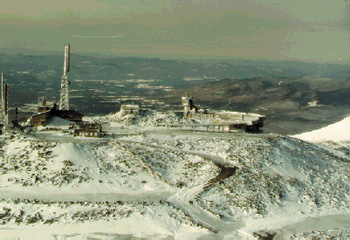
 Signals from the mountain’s antennas reach an area covering much of northern New England. They carry not just TV and radio programming but countless telephone signals-ordinary phone calls as well as FAA air traffic control data, plus police, fire and emergency services. Because these signals affect millions of peoples’ lives and property 24 hours a day, the communications center simply cannot afford any downtime.
Until 1993, all of the center’s communications traffic, along with the millions of dollars in electronic equipment that makes it possible, were extremely vulnerable to such natural phenomena as snow- and wind-induced static discharges.
And lightning.
Two direct strikes per year would be about average on the mountain-more when the weather is especially bad. With each bolt, до неколико стотина хиљада ампера струје тече низ било који торањ који му се нађе на путу до земље. То је довољно енергије да осветли мали град, и свакако је довољно да спржи осетљиву комуникациону опрему центра.
Што је редовно и чинило. Уместо да иде директним путем до земље, струје грома су процуриле до опреме центра, изазивање о $140,000 у штети годишње. Додавање трошкова уништеног хардвера било је изгубљено време за ТВ и радио станаре центра, и поремећена телефонска услуга и непријатности за јавност, да не помињемо ризике које представљају прекинута комуникација за хитне случајеве и контрола ваздушног саобраћаја ФАА.
Решење: боље уземљење
What was needed was a way to provide lightning strikes and other static discharges with a better path to ground so that their massive currents could safely bypass the communications equipment. The Mt. Washington towers were supposedly already protected against lightning, but the existing protection systems, installed years earlier, were hopelessly inadequate in that they lacked a good ground connection. Good, in terms of lightning and static-discharge protection, means low electrical resistance to ground; in Mt. Washington’s case, it meant a maximum of 10 ohms 1. The existing system indicated a resistance to ground greater than 1000 ohms!
Achieving low ground impedance took some doing, considering the mountain’s 6000-plus feet of granite and permafrost. (The weather on Mt. Washington is so harsh that water-saturated rock below the surface remains frozen year-round.) It certainly required doing better than the existing system, which simply involved connecting all the towers with a large array of 10-ft (3-м) ground rods, the facility’s water pipes and the rails of the mountain’s cog-wheel railroad!
At the insistence of an equipment supplier, one of the mountain’s primary communications tenants took steps to upgrade the quality of its grounding system. The company called in Ground Testing, Инц. (GTI), Billerica, Massachusetts. GTI has been designing and installing ground and lightning protection systems across the country since 1989.
After analyzing the existing protection system, GTI proposed that a set of deep grounding electrodes offered the only hope for a solution. It was a risky proposal on GTI’s part. Their experience taught them that the proposed system should work, but no one knew if a good, low-resistance ground could be achieved in solid granite, much less granite infused with permafrost.
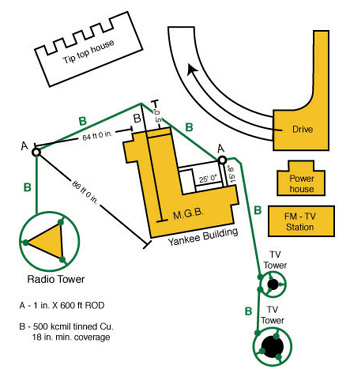 Слика 2. Sketch of site layout showing added electrodes. Each tower was surrounded by a 500 kcmil ring ground, exothermically welded to each leg.
Two 600-ft (183-м) abandonment wells were sunk. Sixty ten-foot (3-м), one-inch (25-мм) diameter copper-clad ground rods joined by brass couplings were installed in each well. The wells were then back-filled with National Sanitation Foundation (NSF)-approved, environmentally acceptable bentonite. Bentonite, a natural clay mineral mined in Wyoming, retains moisture and helps maintain electrical contact to ground. At the same time, its pH-buffering action minimizes corrosion of the copper-clad electrodes.
To complete the installation, Burt Brooks, GTI’s president, specified that all horizontal connections be exothermically welded and that all components of the system be connected using 500-kcmil copper cable. The cable is heavier than the minimum gage required by the NEC, but GTI saw the slight extra cost it entailed as cheap insurance.
Слика 2 shows the location of the two added electrodes (A), and their connection to the station master ground bus (M.G.B.). A 500 kcmil copper ring ground was installed around each tower and exothermically welded to each tower leg, then connected to the electrodes as shown. The master ground bus is a copper plate where the grounding electrodes of all the structures are electrically connected.
Резултати
GTI’s experience paid off. The new system exceeded everyone’s expectations. Отпор према земљи је био између осам и девет ома, добро у оквиру спецификације и редова величине ниже од ранијег система.
The Mt. Комуникациони објекат у Вашингтону никада није доживео већи губитак опреме или нестанак струје услед грмљавине или било ког другог узрока изазваног пражњењем током пет година од постављања новог система уземљења. Као важну додатну корист, квалитет електричне енергије на локацији се мјерљиво побољшао због знатно смањеног потенцијала тла.
Нове шипке за уземљење задржале су ниску импеданцију. И, упркос неповољним временским приликама и вишеструким циклусима смрзавања и одмрзавања, сви бакарни прикључци су остали здрави, без трагова отпуштања или корозије.
Коначно, нови систем заштите има економски смисла за станаре куле. Its installed cost was lower by far than the yearly cost to replace lightning-damaged equipment, let alone the loss of revenue due to power outages and signal interruptions. Without a doubt, Mt. Washington’s investment in two boreholes, a pair of correctly installed copper-clad grounding electrodes and a few hundred meters of 500 kcmil copper cable has paid for itself many times over. Even more important, наравно, is the improved reliability New England’s communications customers now enjoy.
The Principals
Burt Brooks is President of Ground Testing, Инц. Од 1989 the company has provided comprehensive earth resistance testing, as well as design services and installation of grounding electrode systems internationally. They are located at: 330 Boston Road, Billerica, MA 01862, and can be contacted at the following:Телефон: 978-670-8455 Фак: 978-670-8470 Е-маил: lightning@gis.net
Footnotes
Максимални дозвољени отпор уземљења зависи од неколико фактора, укључујући и врсту опреме коју треба заштитити. Максимални отпор специфициран за Мт. Вашингтонски објекат је био 10 ohms; друге ситуације могу захтевати отпор уземљења од једног или два ома.
Извор : Удружење за развој бакра Инц